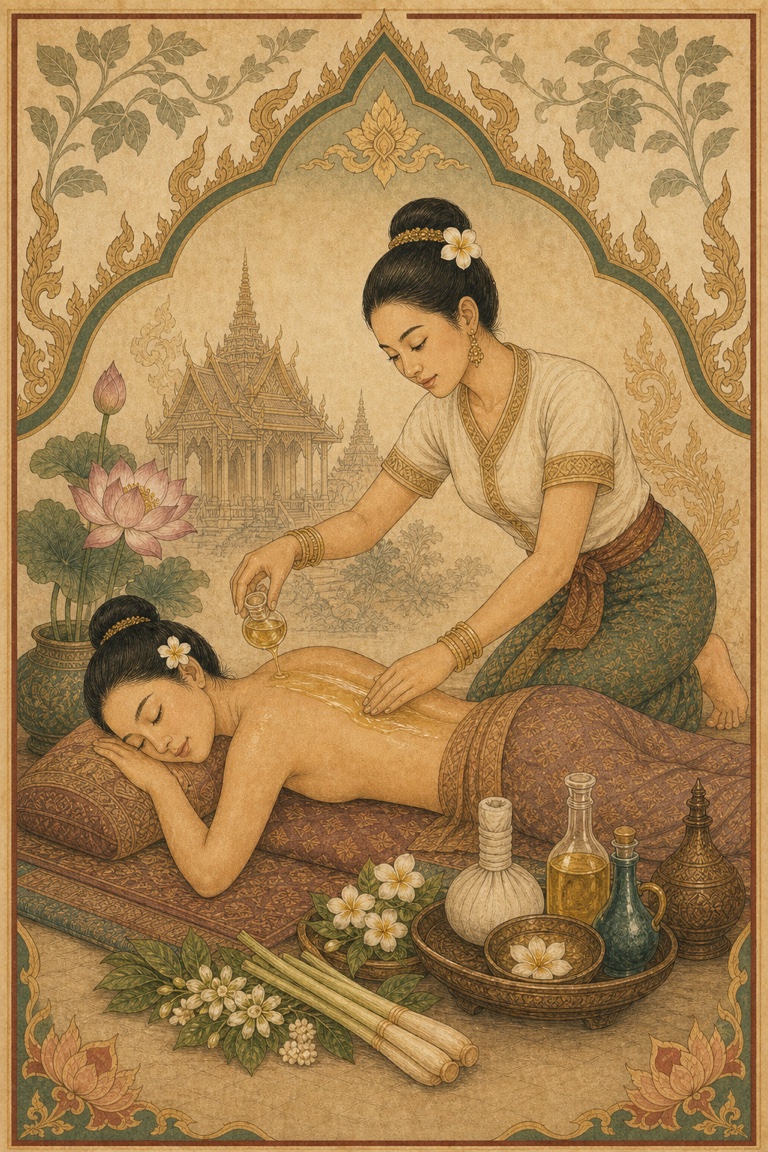
Aroma Oil Massage for Beginners deserves the same depth as any serious massage training topic. This guide is written for students, spa therapists and wellness professionals who want to understand the method behind the treatment rather than memorize a few attractive movements.
A beginner-friendly guide to aroma oil massage foundations, covering posture, draping, rhythm, hygiene, pressure control and what students practice first. The objective is practical education: how to prepare, how to choose or avoid products, how to protect the client, how to build a coherent treatment flow and how to stay inside a responsible professional scope.
Why This Topic Matters
Oil massage and aromatherapy are easy to underestimate because they look soft and relaxing from the outside. In a professional setting, however, the softness is exactly what requires discipline. The therapist must manage product use, draping, rhythm, room temperature, client modesty, pressure and scent exposure at the same time.
A good article should therefore read like a training note, not like a spa menu. The reader should leave with a clearer understanding of what to practice, what to avoid and what questions to ask before touching the client. This is also what makes the article more useful for students: it answers real learning intent with specific, practical information.
Historical and Professional Context
Oil-based massage sits naturally beside traditional Thai bodywork as a table-based spa expression of care. It is less about assisted stretching and more about continuous contact, respectful draping, product knowledge and the ability to create calm without losing technical precision.
Aromatherapy adds another layer. Scent can support the ritual quality of a treatment, but essential oils are concentrated materials and should be handled with professional restraint. The therapist is not simply choosing a pleasant fragrance; the therapist is making a client-care decision that includes dilution, allergies, contraindications and personal preference.
Core Learning Map
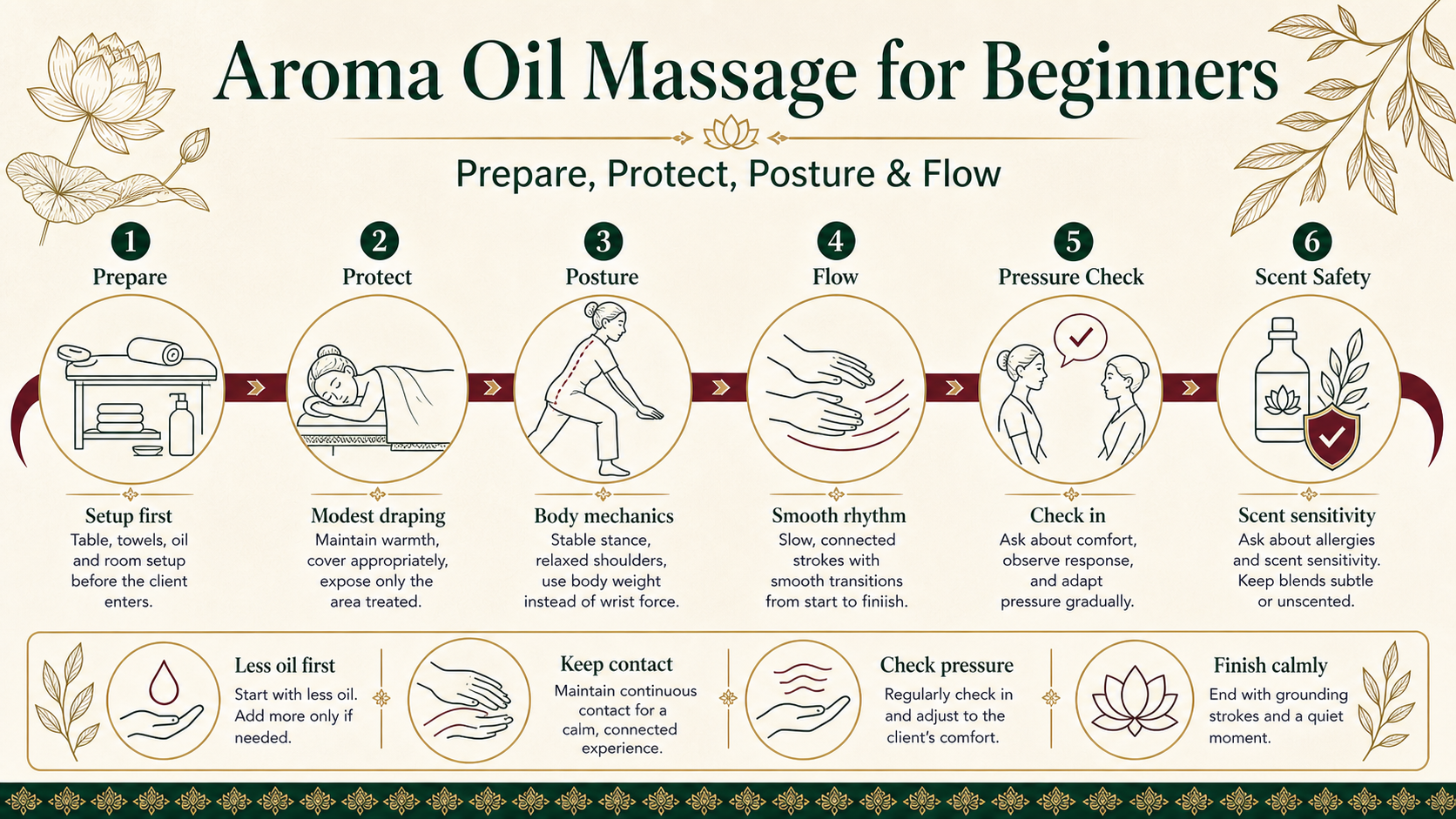
The practical map for this topic can be summarized through 1. Prepare, 2. Protect, 3. Posture, 4. Flow. These are not decorative ideas. They are the checkpoints a student should be able to explain before performing a complete treatment sequence.
What beginners should understand first
Aroma oil massage is often presented as a relaxing treatment, but professional training starts with structure. Before students try to memorize a full routine, they need to understand the treatment room, the table, the towels, the oil setup and the way a client is protected throughout the session.
The first learning goal is not to press harder. It is to move with control, keep the client warm and covered, use the right amount of oil and develop a rhythm that feels calm rather than rushed. This is why beginner training at Nuad Thai School connects technique with spa service standards from the first practice.
Inside a classroom, this point becomes clearer when the instructor demonstrates slowly, then asks the student to repeat the movement while receiving correction on posture, angle, pace and client communication. The value of training is the feedback loop: the student learns not only what to do, but why a small adjustment changes the quality of touch.
The foundation skills
Students learn how to stand beside the table without leaning on the client, how to use body weight instead of tense arms and how to glide without losing contact. They also practice the small details that make oil massage feel professional: towel placement, hand warming, pressure checks and transitions between body areas.
A beginner can learn these foundations safely when the course is practical. Reading about oil massage gives useful vocabulary, but hands-on correction shows whether the pressure, direction, speed and body mechanics are actually clear.
Inside a classroom, this point becomes clearer when the instructor demonstrates slowly, then asks the student to repeat the movement while receiving correction on posture, angle, pace and client communication. The value of training is the feedback loop: the student learns not only what to do, but why a small adjustment changes the quality of touch.
Common beginner mistakes
The most common mistakes are using too much oil, moving too quickly, leaving the client exposed during transitions and working from the wrists instead of the whole body. These habits make the treatment feel less secure even when the intention is good.
In a professional aroma oil massage course, the instructor watches the student perform each movement and corrects the rhythm, angle and pressure before the sequence becomes a habit.
Inside a classroom, this point becomes clearer when the instructor demonstrates slowly, then asks the student to repeat the movement while receiving correction on posture, angle, pace and client communication. The value of training is the feedback loop: the student learns not only what to do, but why a small adjustment changes the quality of touch.
Professional Decision Matrix
| Learning point | How it works | Professional cue |
|---|---|---|
| Setup | Prepare table, oils and towels before the client enters. | Creates calm and avoids interruptions. |
| Draping | Expose only the area being treated. | Protects comfort, warmth and trust. |
| Rhythm | Use slow, connected movements. | Helps the nervous system settle. |
| Pressure | Check comfort and adapt gradually. | Prevents forcing the technique. |
This matrix is useful because it turns broad wellness language into decisions a therapist can actually make. Each row asks the student to connect an action with a reason and a teaching cue. Without that connection, a massage can become a routine performed on autopilot.
In professional training, the instructor should ask students to verbalize these choices. Why this oil? Why this pressure? Why this direction? Why pause here? The ability to answer those questions is part of the transition from casual practice to responsible spa work.
Training Flow
The following flow keeps the lesson structured without making it rigid. A student can use it as a mental checklist before practice, while an instructor can use it to organize demonstration, supervised repetition and correction.
Technique, Pressure and Client Communication
Professional touch has three qualities: it is clear, graded and reversible. Clear means the receiver understands where the contact is going. Graded means the therapist can increase or reduce pressure without surprise. Reversible means the technique can stop immediately when the client needs a change.
For oil massage, the first technical challenge is controlling glide. Too little oil creates drag and tension; too much oil removes precision. The student must learn how to spread product evenly, keep contact secure and still work with anatomical direction rather than sliding randomly over the skin.
Communication should be simple and calm. The therapist can ask whether the pressure feels comfortable, whether the scent is acceptable and whether any area should be avoided. The client should never feel trapped inside a treatment simply because the therapist is following a memorized sequence.
Safety, Contraindications and Honest Claims
Essential oils can irritate skin, trigger scent sensitivity or be inappropriate for some clients. A professional approach uses dilution, keeps blends simple, avoids contact with eyes and mucous membranes, and treats pregnancy, asthma, migraine sensitivity, fragile skin and medical uncertainty with caution.
The FDA notes that aromatherapy products may be regulated differently depending on how they are marketed, and therapeutic claims can change the regulatory category. For a massage school, the safe educational position is clear: teach product handling and client comfort, but do not promise that essential oils diagnose, treat or cure disease.
The NCCIH massage guidance is also a useful reminder that massage is generally about supportive care and should be modified or avoided in some situations. Students should learn referral logic: unexplained swelling, fever, acute injury, severe pain, numbness, skin infection or medical red flags require caution rather than stronger technique.
Common Mistakes and Better Habits
| Common mistake | Why it weakens the treatment | Better professional habit |
|---|---|---|
| Using too much oil | The hands slide without intention and the client feels exposed. | Start with less product, test glide, add only when the skin begins to drag. |
| Rushing the sequence | The nervous system has no time to settle and transitions feel abrupt. | Slow the breath, keep contact continuous and finish each body area before moving. |
| Ignoring scent sensitivity | A pleasant aroma for one person can trigger discomfort for another. | Ask before blending, keep aromas subtle and offer an unscented option. |
| Forcing pressure | The therapist works from the wrists or shoulders and the client guards. | Use stance, body weight and feedback instead of muscular effort. |
How Students Apply This at Nuad Thai School
At Nuad Thai School, this topic should be learned through observation, demonstration, hands-on repetition and direct correction. Students need to feel the difference between a stroke that is beautiful but vague and a stroke that is calm, anatomical and safe.
The training environment matters because oil massage involves privacy and trust. Draping, towel handling, client positioning and room setup are not secondary details. They are part of the treatment. A student who learns them early becomes more confident and more respectful in practice.
Students who want to move from theory into supervised practice can study these foundations in the Private Aroma Oil Massage Course, where the instructor corrects setup, draping, rhythm, pressure and the full treatment sequence.
Student Self-Assessment
- Can I explain the goal of the treatment without making medical claims?
- Did I ask about allergies, scent sensitivity, skin concerns and pressure preference?
- Did I prepare the table, towels and oil before the client entered?
- Can I keep the client covered while changing body areas?
- Do I know when to reduce pressure, pause, avoid an area or refer out?
Continue Learning Aroma Oil Massage
This guide is part of the Nuad Thai School oil massage and aromatherapy learning cluster. For supervised hands-on practice, explore the Private Aroma Oil Massage Course in Bangkok.
FAQ
Can a complete beginner learn aroma oil massage?
Yes. A beginner can start with table setup, simple gliding techniques, safe draping and pressure awareness before learning a longer sequence.
Is aroma oil massage only for relaxation?
Relaxation is important, but a good course also teaches body mechanics, hygiene, client communication and professional flow.
What is the best first step?
Start with safe setup and basic effleurage, then practice under correction so the rhythm and pressure become consistent.
Conclusion
Aroma Oil Massage for Beginners becomes valuable when it is taught with context. Technique gives the hands something to do, but safety, consent, anatomy, product knowledge and supervised repetition give the treatment professional quality.
For students comparing massage schools in Bangkok, this is the standard to look for: a course that teaches the beauty of the treatment and the judgment behind it. A confident therapist is not the person who uses the strongest pressure or the most oils; it is the person who can adapt, explain, protect and deliver a complete experience with care.