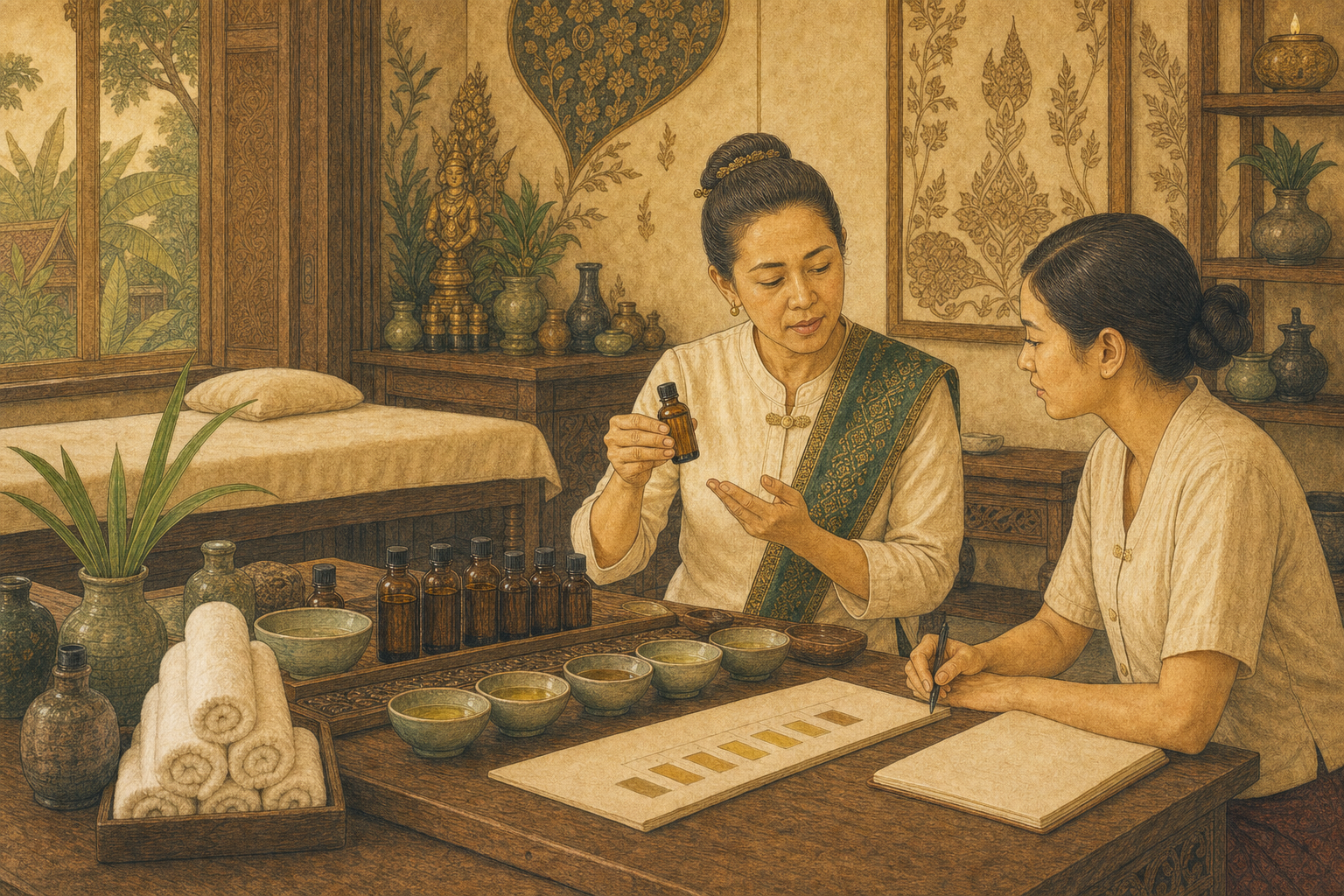
Carrier Oils and Massage Training: What Students Should Know is written as a serious training guide for students, spa therapists and wellness professionals. It connects a course topic offered by Nuad Thai School with anatomy, technique, safety, current research watch signals and practical classroom application.
The answer in short: this subject should be taught through skin barrier, superficial fascia, scent sensitivity, olfactory response and relaxation physiology, then practiced through effleurage, kneading, forearm glide, draping, oil amount and seamless full-body flow. The safe boundary is equally important: dilute essential oils, ask about allergies, avoid photosensitivity risks and keep aromatherapy claims conservative.
Key Takeaways
- This article belongs to the Oil Massage topic and links naturally to the Private Aroma Oil Massage Course.
- Good massage education explains what the therapist does, which tissues are involved, why pressure is adapted and when a technique should be avoided.
- Medical, anatomical and scientific vocabulary is used for education only, not to diagnose or promise treatment outcomes.
- The article is structured for clarity: direct answers, specific subtopics, FAQ language, source links and clear safety boundaries.
Research Watch and Why It Matters
Before developing the article, the generator checks authoritative standing sources and a recent PubMed watch query. This keeps the writing anchored in credible information instead of repeating generic spa marketing.
Recent literature scanning did not return a usable title during this run.
The generator does not turn every research title into a medical claim. It uses the watch layer to choose better angles: anatomy, contraindications, therapist education, client communication and responsible wording.
Anatomy and Physiology
For this subject, the anatomical focus is skin barrier, superficial fascia, scent sensitivity, olfactory response and relaxation physiology. A student should be able to identify the relevant region, explain why the pressure is light or deep, and name the structures that require caution.
Anatomy helps students avoid vague routines. Instead of memorizing movements, they learn to ask: where is the contact, what is the tissue response, what does the client report, and what should change if discomfort appears?
Technique and Classroom Method
The practical technique focus is effleurage, kneading, forearm glide, draping, oil amount and seamless full-body flow. In class, this should be demonstrated slowly, practiced under correction and repeated until the student can keep posture, rhythm and pressure consistent.
A serious massage article should make the invisible parts of technique visible: stance, breath, angle, towel management, consent, pressure scale and the ability to stop immediately.
Complete Infographic
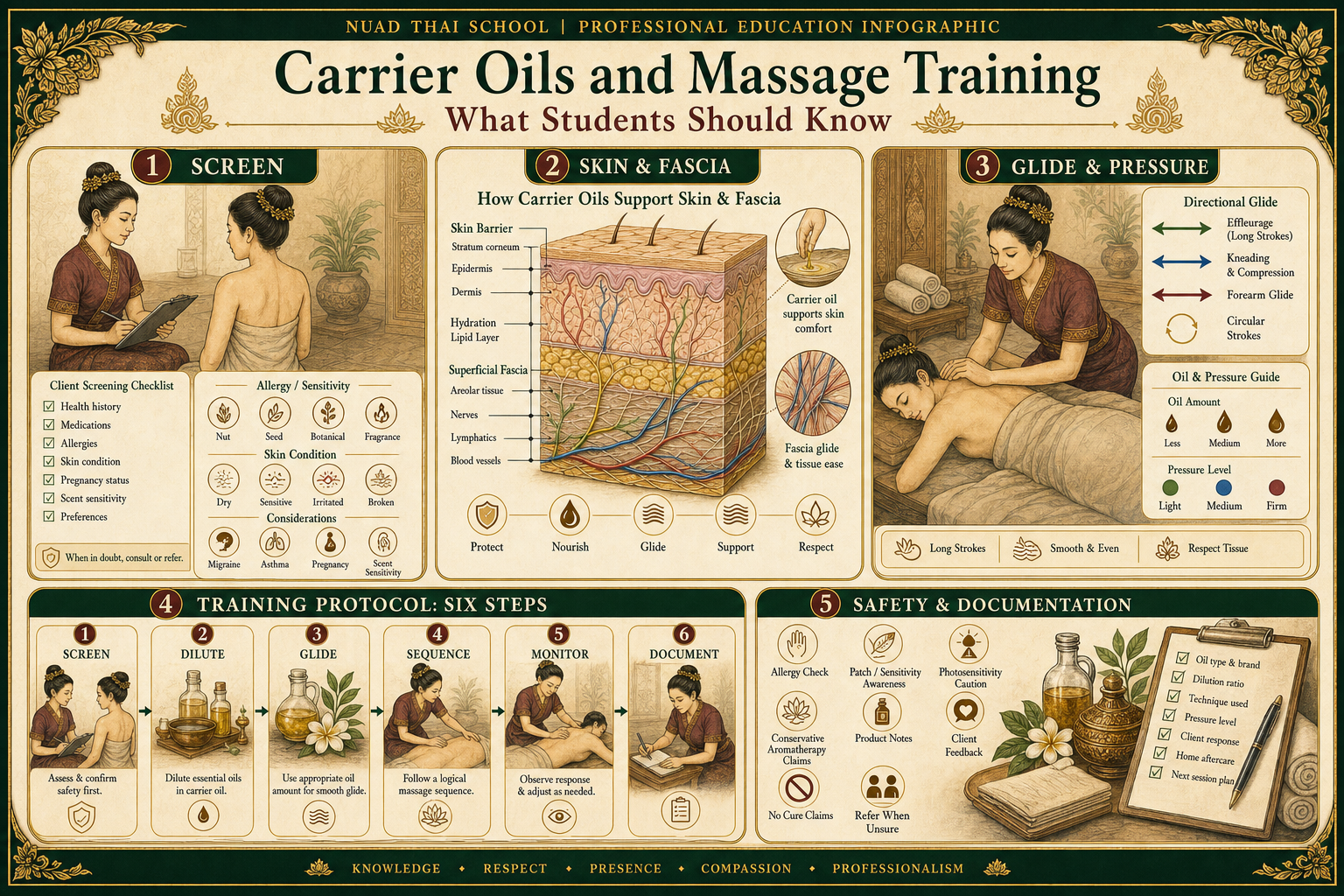
Professional Decision Matrix
| Layer | What to cover | Training cue |
|---|---|---|
| Anatomy | skin barrier, superficial fascia, scent sensitivity, olfactory response and relaxation physiology | Name the tissues and vulnerable structures before choosing pressure. |
| Technique | effleurage, kneading, forearm glide, draping, oil amount and seamless full-body flow | Teach movement slowly, then add rhythm and feedback. |
| Safety | dilute essential oils, ask about allergies, avoid photosensitivity risks and keep aromatherapy claims conservative | Modify, stop or refer when the client's condition requires it. |
| Course path | Private Aroma Oil Massage Course | Connect the topic to supervised practice in the related course. |
Safety, Contraindications and Scope
The safety focus is clear: dilute essential oils, ask about allergies, avoid photosensitivity risks and keep aromatherapy claims conservative. This section is essential for trust because it shows that the school is not making exaggerated wellness promises.
Massage education can discuss anatomy, physiology, relaxation, mobility and comfort. It should not claim to cure disease. Readers with medical symptoms should consult qualified health professionals, and students should learn referral logic early.
Training Path at Nuad Thai School
Students who want to move from reading to supervised practice can study this subject through the <a href="/courses/aroma-oil-massage/">Private Aroma Oil Massage Course</a>. The article gives the theory; the course gives correction, repetition and body mechanics.
This is where the old Thai drawing style of the banner and the advanced educational SVG infographic work together: one communicates cultural identity, the other explains the learning system in a premium, scannable way.
FAQ
Is Carrier Oils and Massage Training: What Students Should Know a medical treatment?
No. It is presented here as massage education and spa training. It may support comfort or relaxation for some clients, but it should not be used to diagnose, treat or cure disease.
Why include anatomy in a massage school blog article?
Anatomy helps students understand pressure, direction, contraindications and adaptation. It makes technique safer and more professional.
How does the generator choose topics?
It chooses a random course-related category to keep the blog diverse, then builds a topic connected to Nuad Thai School courses and checks credible research sources before writing.