UTTS certification Private massage academy in Bangkok Operated by Loft Thai Spa
Resources

Oil Massage

Aroma Oil Massage Safety: Essential Oils, Skin and Nervous System

Aroma Oil Massage Safety: Essential Oils, Skin and Nervous System

Aroma Oil Massage Safety: Essential Oils, Skin and Nervous System is a professional guide for students, spa therapists and wellness teams who want to use aromatic oils with skill instead of habit. Aroma oil massage can feel simple from the outside: choose a pleasant scent, apply oil, glide smoothly and help the client relax. In training, however, the subject deserves much more precision. A therapist must understand the skin barrier, dilution, allergy screening, scent sensitivity, nervous-system response, draping, pressure, hygiene and the limits of what aromatherapy can responsibly claim.

The short answer is this: a safe aroma oil massage begins before the first stroke. The therapist chooses a suitable carrier oil, dilutes essential oils conservatively, asks about allergies and fragrance sensitivity, checks contraindications, explains the treatment, and observes the client throughout the session. The goal is not to “treat” the nervous system or cure medical conditions. The professional goal is to create a calm, well-paced massage experience where touch, scent, warmth, rhythm and client communication support comfort and relaxation within a clear scope of practice.

Key Takeaways

  • Aroma oil massage is a hands-on massage discipline, not just a fragrant add-on to a basic routine.
  • Essential oils should be diluted into a carrier oil before skin contact, and therapists should use conservative blends for training and public spa work.
  • The most important safety checks are allergy history, fragrance sensitivity, pregnancy status, skin irritation, medication concerns, sun exposure risk and client consent.
  • Students should understand the skin barrier and superficial fascia so they can choose pressure, oil amount and rhythm with better judgment.
  • The nervous system should be discussed in educational language: relaxation, perceived calm, breath, comfort and sensory response, not medical treatment claims.
  • This topic connects naturally to the Private Aroma Oil Massage Course, where students can practice oil handling, draping, flow and pressure under correction.

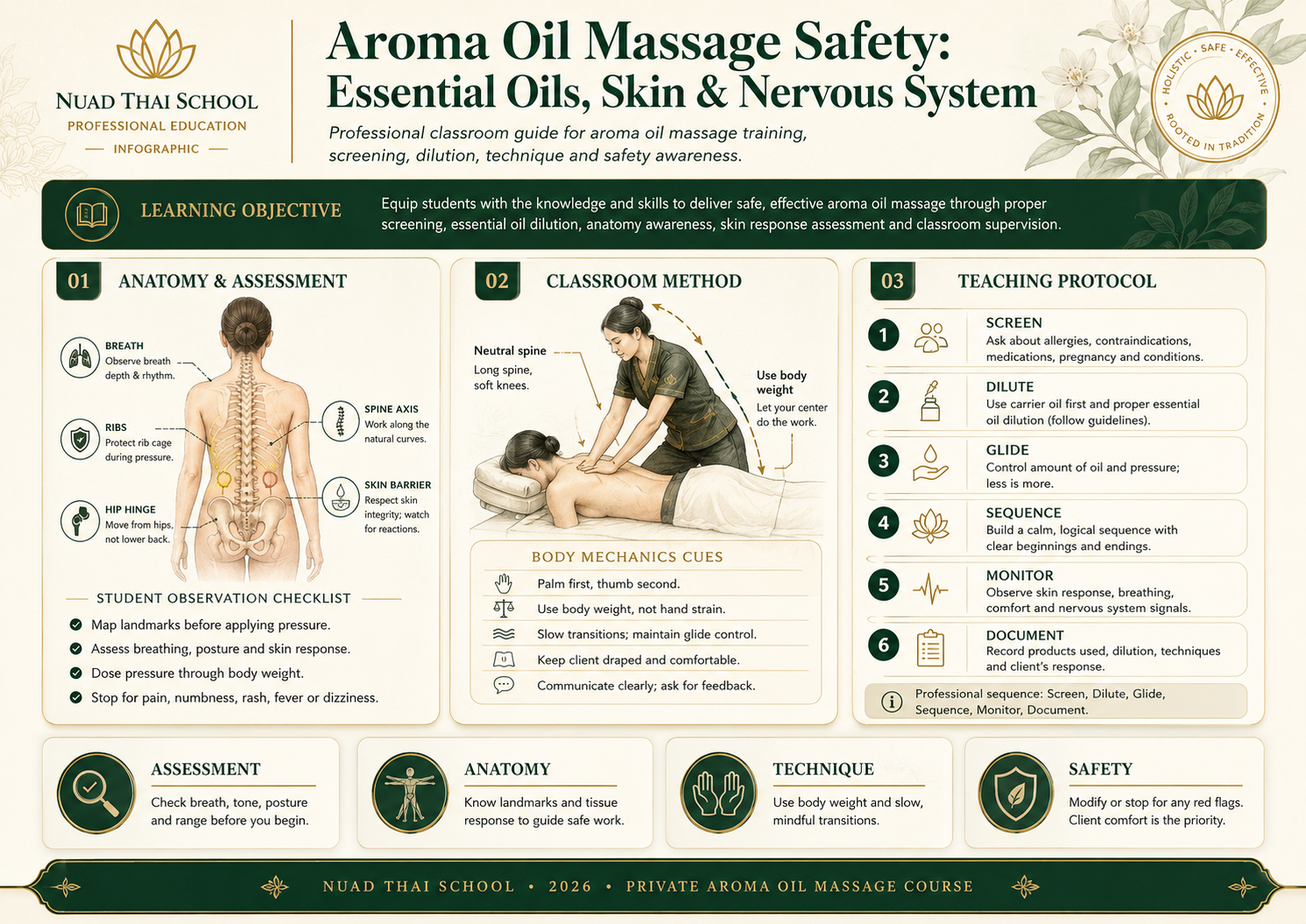
Complete Infographic

Infographic explaining aroma oil massage safety including skin barrier checks, dilution, scent sensitivity, draping, nervous system cues and stop or refer signals
Aroma oil massage safety: essential oils, skin checks, scent sensitivity and professional boundaries.

Why Aroma Oil Massage Safety Matters

Many beginners imagine aroma oil massage as a soft, easy technique because the movements are often slower and smoother than dry Thai massage. In reality, oil work asks for a different kind of control. The therapist cannot rely on friction in the same way, and the skin is exposed to products for a longer period. The client may also react to scent before any touch begins. That means safety is not only about pressure. It is also about chemistry, product choice, client communication and the sensory environment.

Essential oils are concentrated aromatic extracts. They are not the same as carrier oils such as coconut, sweet almond, grapeseed, jojoba or rice bran oil. A carrier oil provides glide and helps reduce friction on the skin. An essential oil contributes scent and botanical character, but it should normally be used in a diluted blend for massage. A professional student must know the difference because confusing the two can lead to overuse, skin irritation or unsafe claims.

In a school setting, safety also protects the therapist’s future career. A spa client may not know how to explain a sensitivity, may feel shy about asking for a lighter scent, or may not immediately connect a skin reaction with a product used during massage. A trained therapist creates space for that information before the treatment starts. This is why intake questions, product labeling and simple documentation matter.

Skin Barrier: The First Safety Layer

The skin is not just a surface for applying oil. It is a living barrier that helps protect the body from water loss, irritants, microorganisms and environmental stress. In massage training, students should learn to observe skin condition before applying any product. Dryness, broken skin, rashes, inflammation, recent shaving irritation, sunburn, abrasions or unknown lesions are all reasons to adapt, avoid a region or refer the client to a qualified health professional.

Oil changes the tactile relationship between hand and skin. With too little oil, the therapist may drag the skin and create uncomfortable friction. With too much oil, the hand may slide without control, the therapist may lose contact quality, and the client may feel exposed or greasy rather than supported. Correct oil amount is therefore a technical skill. It should be taught through measured application, warm hands, even distribution and progressive adjustment, not by pouring more product whenever the stroke feels difficult.

Students should also understand that skin response can be delayed. Redness immediately after massage may be simple warmth and circulation, but persistent burning, itching, swelling, hives or unusual discomfort should be treated seriously. The professional response is to stop, remove product if appropriate, document the event and recommend medical advice when symptoms are significant. The therapist should not diagnose the reaction or promise that it is harmless.

Essential Oils, Dilution and Product Discipline

Essential oil safety begins with restraint. Stronger fragrance does not mean better treatment. In many spa contexts, a low dilution is more professional because clients vary widely in sensitivity, health status, preferences and cultural expectations around scent. A conservative blend also helps students focus on touch quality instead of hiding poor technique behind a powerful aroma.

For general training, students should learn the concept of percentage dilution rather than guessing by smell. A school may set its own protocol, but the principle is consistent: essential oils are used in small amounts within a carrier oil, and the formula should be repeatable. Labels should identify the carrier, the essential oils, the date of blending and any known precautions. This matters when several students share a classroom, when clients return for another session, and when a teacher needs to trace what was used.

Some essential oils can increase photosensitivity, especially certain expressed citrus oils. If a client will be exposed to strong sun after treatment, the therapist should avoid photosensitizing oils or choose a safer alternative according to school protocol. This is especially relevant in Bangkok, where sun exposure, heat and travel plans are common parts of a visitor’s day. The safest education is practical: students learn which oils require caution, where the product will be applied, whether the client will shower, and what aftercare advice is appropriate.

Students should also be careful with claims. An essential oil may be associated with a traditional use or a pleasant perceived effect, but a massage school article should not claim that it cures anxiety, treats neurological disease, balances hormones or replaces medical care. Better wording is accurate and professional: “lavender is often chosen for a calming scent,” “citrus aromas may feel bright or refreshing to some clients,” or “the therapist should adapt scent intensity to the client’s preference.”

Scent Sensitivity and the Nervous System

Aroma enters the client experience through smell before touch is even evaluated. The olfactory system is closely linked with memory, emotion and perceived comfort, which is why scent can quickly make a room feel welcoming or overwhelming. This does not mean the therapist is controlling the nervous system. It means scent is a strong sensory input, and professional therapists should use it with permission, moderation and observation.

A calm massage room is built from several inputs at once: scent, temperature, lighting, sound, therapist pace, draping security, pressure and silence. If one input is too strong, the entire experience can become stressful. A client who dislikes a scent may breathe shallowly, tense the shoulders, become distracted or wait politely for the treatment to finish. The therapist may think the massage is relaxing, while the client is simply enduring it. This is why a simple question such as “Is this scent comfortable for you?” can be more professional than a long explanation of aromatherapy theory.

The nervous-system language used in training should remain grounded. Students can learn that slow rhythm, predictable touch, comfortable warmth and secure draping may support a relaxation response for many clients. They can observe breathing, muscle guarding, facial expression and verbal feedback. They should avoid claiming that a specific oil “resets” the nervous system or treats a medical condition. The best therapists are precise because precision builds trust.

Contraindications and When To Adapt

Aroma oil massage is not suitable for every client in the same way. Students should learn to screen for allergies, asthma or fragrance sensitivity, migraine triggered by scent, pregnancy, breastfeeding, recent surgery, acute skin conditions, fever, infection, unexplained pain, severe swelling, numbness, clotting concerns, active inflammation and medical treatment that may affect skin or sensation. The therapist’s role is not to make a medical decision. The role is to recognize when massage should be modified, postponed or referred.

Pregnancy deserves special care. Some clients book oil massage because they want gentle relaxation, but pregnancy changes positioning, pressure tolerance, circulation considerations and product choice. A student should not improvise essential oils for pregnant clients. They should follow school protocol, keep claims conservative, avoid risky products and use referral logic when unsure. The most professional phrase is often simple: “Let me check the safest option before we proceed.”

Children, elderly clients and people with sensitive skin also require caution. Their skin may respond differently, and they may not describe discomfort clearly. For training purposes, it is safer to develop a default approach that is mild, transparent and easy to stop: minimal fragrance, simple carrier oil, clear consent and frequent feedback. Advanced blending can come later, after students have mastered safe fundamentals.

Technique: Glide, Pressure and Draping

Good aroma oil massage is not just sliding hands over the body. The therapist must create a continuous flow while keeping anatomical intention. Effleurage can warm tissue and distribute oil. Kneading can address superficial muscular tension. Forearm glide can cover larger areas when taught carefully. Transitions should be smooth, but they should not become vague. Every stroke needs direction, pressure control and respect for client boundaries.

Draping is part of safety. Oil massage often exposes more skin than dry Thai massage, which means the client’s sense of privacy must be protected. Towels should be placed before oil is applied, adjusted with clear communication, and kept secure during transitions. Students should practice draping until it becomes calm and automatic. A therapist who fumbles with towels or leaves the client feeling uncovered can break trust, even if the hand technique is technically correct.

Pressure should be adapted because oil reduces friction. Deep work with oil can feel intense quickly if the therapist uses body weight without control. Students should learn to begin broad, slow and moderate, then ask for feedback before increasing depth. The pressure scale should be explained in plain language: comfortable, too light, too strong, sharp, burning, numb or unusual. A client should never feel that they must tolerate discomfort because the session is “supposed” to be therapeutic.

Professional Decision Matrix

LayerWhat to checkTraining cue
SkinBarrier condition, irritation, broken skin, sunburn, sensitivityObserve before oil contact and avoid irritated areas.
ProductCarrier oil, essential oil dilution, label, freshness, photosensitivity riskUse measured blends and document what touches the skin.
ScentPreference, headache history, asthma, nausea, emotional comfortLet the client smell the blend first and reduce intensity when unsure.
TechniqueGlide, pressure, rhythm, draping, transitions, oil amountUse enough oil for comfort, not so much that control is lost.
ScopeMedical symptoms, pregnancy questions, medication concerns, unusual reactionsModify, stop or refer rather than making treatment claims.

Classroom Method at Nuad Thai School

In the Private Aroma Oil Massage Course, this topic should be taught through demonstration, supervised repetition and correction. Students need to see how little oil is required, how the teacher warms the product in the hands, how draping is prepared, how pressure is introduced and how the therapist checks the client’s comfort without interrupting the flow. These details are difficult to learn from text alone.

A useful classroom exercise is to compare three versions of the same stroke: too little oil, too much oil and correct oil amount. Students immediately feel how product quantity changes control. Another exercise is scent testing with neutral language. Instead of saying “this oil is relaxing,” the teacher asks students to describe the scent intensity, personal preference and possible client concerns. That shift trains professional observation.

Students should also practice stopping. In real spa work, stopping gracefully is a skill. If a client reports itching, dizziness, headache, nausea, burning or emotional discomfort, the therapist should pause without panic, check what is happening and adjust. The goal is not to defend the product or technique. The goal is client safety and trust.

Aftercare and Client Communication

Aftercare should be simple and practical. The therapist may advise the client that oil remains on the skin, that they can shower if they prefer, and that they should avoid strong sun exposure if photosensitive oils were used according to the product protocol. The therapist should not overload the client with medical instructions. If there is any unusual reaction, the client should be encouraged to seek qualified medical advice.

Communication also includes consent around scent. Some clients love aromatic oils; others prefer unscented massage. An unscented carrier oil should be respected as a professional option, not treated as a lesser experience. In fact, the ability to deliver a beautiful massage without strong scent is a sign that the therapist’s technique is real. Aroma should refine the session, not carry it.

Sources and Research Watch

The practical research position is conservative: aromatherapy can be discussed as a sensory and wellness practice, but medical claims require evidence, context and professional scope. For a massage school, the safest and most useful educational angle is product safety, client screening, clear language and skilled touch.

FAQ

Can essential oils be applied directly to the skin during massage?

In professional massage training, essential oils should normally be diluted in a carrier oil before skin application. Direct application increases the risk of irritation and is not appropriate as a casual classroom habit.

Is a stronger aroma better for relaxation?

No. A stronger aroma can become overwhelming for some clients. A subtle scent, client consent and good massage rhythm are usually more professional than a powerful fragrance.

What should a therapist do if the client reports itching or burning?

The therapist should stop, check the area, remove product if appropriate, document what was used and advise medical support if symptoms are significant or persistent. The therapist should not diagnose the reaction.

How does this article support SEO and AI search?

It gives direct answers, precise safety language, a structured table, a complete infographic, internal course links, credible source links and FAQ wording. This helps search engines and AI systems understand the page as an educational resource, not just a promotional spa article.

Where can students practice this safely?

Students can practice oil amount, draping, safe pressure, scent communication and professional flow in the Private Aroma Oil Massage Course at Nuad Thai School, where correction and repetition are part of the learning process.