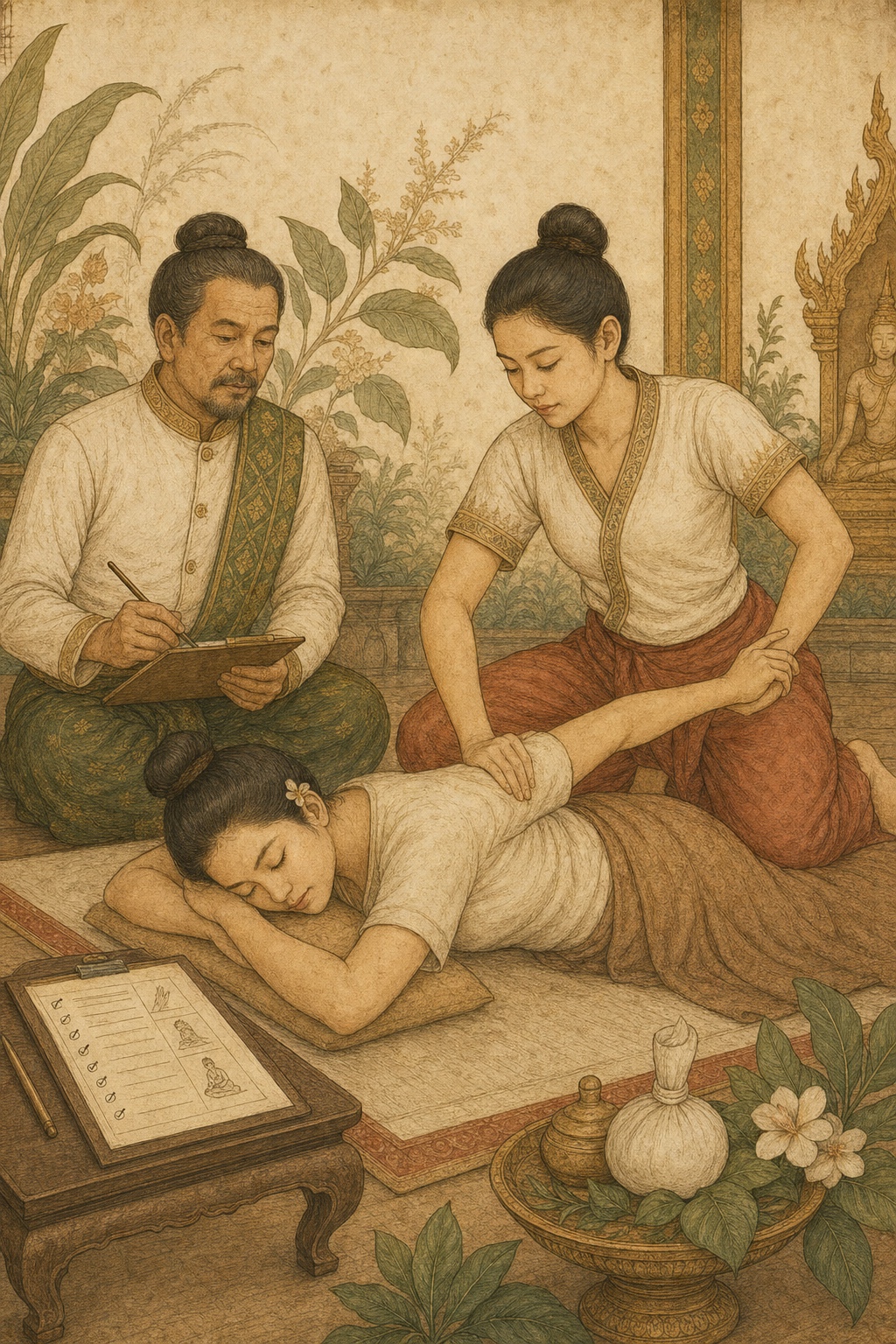
Recruiting a massage therapist is not only a question of finding someone with good hands. A spa, wellness clinic or hotel needs a therapist who can work safely, communicate clearly, respect hygiene standards, adapt pressure, understand guest comfort and represent the brand with steady professional judgment. A candidate may look strong on a CV, but the real answer usually appears during a structured assessment: how they prepare the room, how they ask questions, how they touch, how they respond to feedback and how honestly they describe their own limits.
This guide explains how to evaluate a massage therapist candidate for recruitment in a practical, fair and repeatable way. It is written for spa owners, managers, trainers and recruitment teams who need to compare candidates without relying on intuition alone. The same framework can be used for Thai massage, aroma oil massage, foot reflexology, facial treatment, sport massage or general spa therapy roles. It also connects naturally with Nuad Thai School's international Thai therapist recruitment support, where assessment, training background and candidate presentation all matter before a therapist is introduced to a client or employer.
The Short Answer: Evaluate Skill, Safety and Service Together
A strong massage recruitment process should combine seven layers: document screening, interview, practical technique trial, hygiene and setup observation, safety judgment, communication ability and final recommendation. None of these layers is enough by itself. A therapist with beautiful technique but poor hygiene is a risk. A therapist with a charming interview but weak body mechanics may struggle in real service. A candidate with years of experience but no ability to adapt pressure may create inconsistent guest outcomes.
The goal is not to create a stressful exam. The goal is to understand whether the candidate can perform reliably in the environment where they will work. A luxury hotel spa, a busy urban wellness center and a destination retreat may all need different personalities and strengths. The assessment should therefore measure fundamentals first, then match the candidate to the right role.
1. Start With the Role Profile Before You Meet the Candidate
Many recruitment mistakes happen before the interview begins. A spa says it needs a massage therapist, but the actual role is more specific: Thai massage specialist, oil massage therapist, senior therapist, trainer, facial and body treatment therapist, mobile therapist, hotel spa therapist or international placement candidate. Each role has different requirements. A senior therapist may need mentoring ability. A hotel therapist may need English conversation, guest etiquette and documentation discipline. A Thai massage therapist may need safe stretching, mat work and body weight control.
Before evaluating any candidate, write a role profile with five questions. What treatments will the therapist actually perform? What level of guest communication is required? What schedule, relocation or visa conditions matter? Which techniques are essential on day one, and which can be trained later? Which red flags are non-negotiable? This role profile prevents the recruiter from overvaluing one impressive skill while ignoring a weakness that will matter every day.
A useful role profile also defines the minimum evidence needed. For example, an international spa recruitment role may require a current CV, training certificates, reference checks, passport readiness, English conversation level, video or live practical assessment and a final client presentation profile. A local spa hiring role may focus more on availability, commute, trial shift, hygiene habits and team fit. The candidate should be assessed against the role, not against a vague ideal.
2. Review Documents Without Being Blinded by Certificates
Documents are important, but they are only the first filter. A CV can show work history, treatment categories, years of experience and career direction. Certificates can show that the candidate completed training. References can confirm past conduct. However, documents do not prove current technique, safety judgment or service consistency. Recruiters should treat paperwork as a map, not as the destination.
Check whether dates make sense. Look for unexplained gaps, very short jobs, unclear school names or treatment claims that sound too broad. Ask the candidate to explain where they trained, who corrected their technique, what treatments they performed most often and which treatments they would not perform without more practice. A mature therapist can describe their own scope honestly. A risky candidate often says yes to everything.
For Thai massage recruitment, training history matters because Nuad Thai is a technical discipline with cultural, physical and safety dimensions. The World Health Organization's benchmark publication on Nuad Thai training is a useful reminder that serious training includes more than memorizing sequences; it includes principles, practical skills, professional conduct and safe application. A recruiter does not need to turn the interview into an academic test, but they should expect a candidate to explain pressure, contraindications, body mechanics and client communication in simple language.
3. Use a Structured Interview, Not Casual Conversation
The interview should be warm, respectful and structured. Start with open questions: "Tell me about the treatments you perform most often." "Which type of client do you work with best?" "What do you check before starting a session?" "What would make you stop or modify a treatment?" These questions reveal how the candidate thinks. A professional therapist will talk about client goals, comfort, pressure, medical history, hygiene, contraindications and feedback. A weaker candidate may talk only about routine names or years of experience.
Then ask scenario questions. A guest asks for very deep pressure but reports numbness down the arm. What do you do? A client arrives late and wants the full treatment time. How do you handle it? A client says the room is cold but seems shy about complaining. What do you change? A candidate's answer should show boundaries, communication and service attitude. You are not looking for perfect scripted answers. You are looking for safe reasoning.
Interview notes should be scored, not simply remembered. Motivation, availability, relocation readiness, salary expectations, strengths and development areas should be recorded in the same format for every candidate. This protects the employer from inconsistent decisions and gives the candidate a fairer process. If a candidate is not selected, the team can still understand why.
4. Observe the Setup Before the First Technique
The practical assessment begins before the candidate places a hand on the client. Watch how they prepare the room, arrange towels, sanitize hands, handle oil or equipment, check the treatment area and position themselves. Hygiene and setup reveal professional habits. A therapist who rushes preparation may also rush safety. A therapist who organizes the space calmly often brings that same quality into the session.
Use a simple setup checklist: clean hands, tidy station, correct towel placement, respectful draping, clear walking space, appropriate product amount, safe room temperature and professional appearance. If the candidate is being assessed on mat-based Thai massage, observe mat placement, knee comfort, client positioning and how the therapist manages transitions. If the candidate is being assessed on oil massage, observe product control, privacy, towel discipline and glide without overusing oil.
This stage is also where service attitude becomes visible. Does the candidate greet the model client properly? Do they explain what will happen? Do they ask about comfort before starting? Do they speak too much, too little or in a way that feels mechanical? Good service is not theatrical. It is calm, respectful attention.
5. Score Practical Technique by Observable Behaviors
A practical trial should be long enough to observe fundamentals but not so long that it becomes a free treatment. For many recruitment contexts, 20 to 40 minutes is enough. Ask the candidate to demonstrate core techniques relevant to the role: Thai massage pressure and stretching, oil massage flow, foot reflexology pressure control, facial treatment hygiene, sport massage recovery pacing or client-specific adaptation. Give the same task to comparable candidates.
Score what you can observe. Body mechanics: does the therapist use body weight instead of hand strain? Pressure control: can they increase or reduce pressure smoothly? Contact quality: is the touch confident, warm and stable? Rhythm: does the session feel organized rather than random? Transitions: can they move the client safely? Client feedback: do they check comfort without interrupting too much? Technique maturity is visible in small details.
A candidate does not need to perform every technique perfectly. Recruitment is about fit and trainability. A therapist with good posture, clean touch, humble feedback and safe judgment may be an excellent hire even if one technique needs polishing. A therapist with flashy movements but poor pressure control may create more risk than value. The assessment should distinguish between teachable gaps and core weaknesses.
6. Test Safety Judgment Explicitly
Safety cannot be assumed from experience. Every candidate should be asked about contraindications, referral logic and scope of practice. For example: when would you avoid deep pressure? What would you do if a client reports sharp pain? How do you adapt for pregnancy, fever, inflammation, recent injury or unexplained swelling? What do you say when a client asks if massage can cure a medical problem?
The safest answer is not fear. It is judgment. A professional therapist knows when to modify, when to ask more questions, when to stop and when to refer the client to a qualified healthcare professional. The NCCIH overview of massage therapy is useful here because it frames massage as a wellness and health-related practice without encouraging exaggerated claims. Recruiters should listen for conservative language: support, comfort, relaxation, mobility, tension relief and referral when symptoms are outside massage scope.
Safety also includes boundaries. The candidate should understand draping, consent, respectful communication, privacy, hygiene and documentation. In international recruitment, these boundaries are even more important because therapists may be placed in a new culture, language and service standard. A candidate who can explain boundaries clearly is easier to train, easier to present to clients and safer to employ.
7. Evaluate English and Client Communication Separately
Language ability should be measured according to the role. Not every excellent therapist needs advanced English. However, many spa positions require basic client interaction: greeting, consultation questions, pressure check-ins, aftercare advice and the ability to understand discomfort. Score speaking, listening, vocabulary and client interaction separately. A candidate may have modest grammar but excellent listening and warm client care. That can be enough for some roles.
Use practical language prompts rather than abstract grammar tests. Ask the candidate to explain a treatment in English, ask three consultation questions, respond to a client who wants stronger pressure and give simple aftercare advice. The goal is real service communication. The candidate should be able to protect the client experience: "Please tell me if the pressure is too strong," "Do you have any injury today?" "I will avoid this area," "Please drink water and rest after the session." Clear, simple English is often better than memorized formal sentences.
For client-facing international recruitment, English scoring should be honest in the candidate report. A score of 7/10 may be perfectly usable if the candidate is confident, polite and willing to improve. A score of 4/10 may still be acceptable for a back-of-house or local-language environment but not for a premium international placement requiring guest consultation.
8. Use a Weighted Scorecard
A scorecard helps the recruitment team compare candidates consistently. The exact weights can change by role, but a practical starting point is: 30 percent practical technique, 20 percent safety and hygiene, 15 percent communication, 15 percent work experience, 10 percent attitude and coachability, and 10 percent availability or role fit. A senior therapist role may increase experience and training leadership. A junior therapist role may increase attitude and coachability.
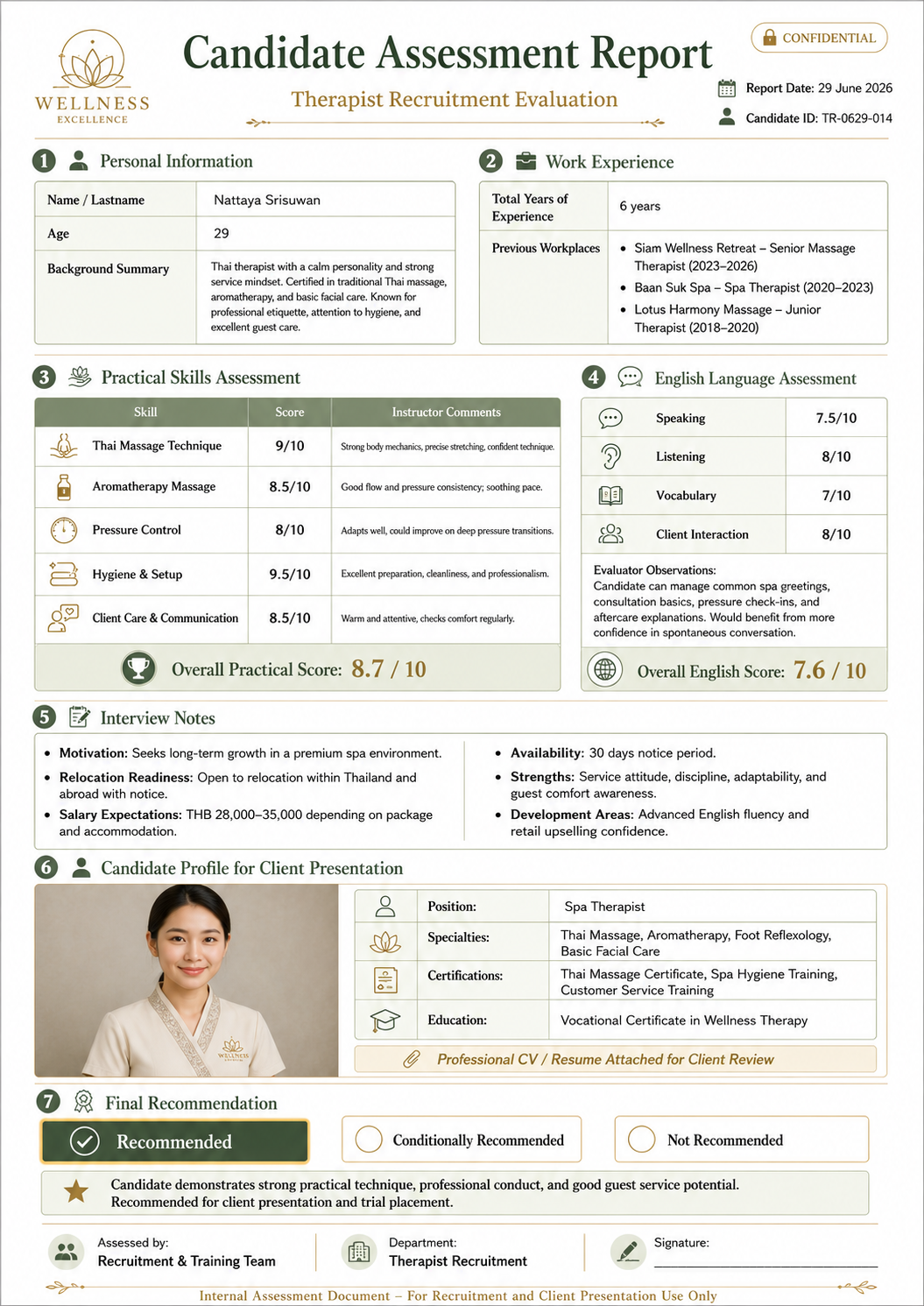
A good scorecard includes comments, not just numbers. "8/10 pressure control" is less useful than "adapts pressure well, but transitions into deep work too quickly." Comments help trainers design onboarding. They also help the recruitment team explain the recommendation to a spa client. If a candidate is conditionally recommended, the condition should be specific: improve English confidence, complete oil massage refresher, practice towel management, or demonstrate two additional treatments before placement.
| Assessment Layer | What to Observe | Recruitment Decision Signal |
|---|---|---|
| Documents | CV, certificates, references, work dates and treatment scope | Consistent history and honest limits |
| Practical Skill | Body mechanics, pressure, rhythm, transitions and treatment flow | Stable technique under observation |
| Safety | Contraindications, consent, hygiene, draping and referral logic | Clear boundaries and conservative claims |
| Communication | Greeting, consultation, pressure check-ins and aftercare language | Client can understand and feel respected |
| Fit | Availability, relocation, salary range, attitude and coachability | Candidate can succeed in the actual role |
9. Separate Recommended, Conditionally Recommended and Not Recommended
The final recommendation should be clear. "Recommended" means the candidate can be presented or hired for the target role with normal onboarding. "Conditionally recommended" means the candidate has strong potential but needs a specific condition before placement. "Not recommended" means the gap is too large, the risk is too high or the role does not match the candidate.
Do not use conditional recommendation as a polite way to avoid a difficult decision. If the therapist needs two weeks of training, say so. If the therapist is technically strong but not ready for English-speaking guests, say so. If the therapist has excellent attitude but insufficient practical skill, record that honestly. Good recruitment is not about making every candidate look perfect. It is about matching the right candidate to the right environment.
The ILO's fair recruitment guidance is relevant for employers and recruiters because process quality matters. Candidates should understand the role, conditions, costs, expectations and selection steps. A professional assessment protects the employer, but it should also protect the worker from misleading promises or unclear placement decisions. Fairness is part of quality.
10. Turn the Assessment Into Onboarding
The best recruitment assessment does not end when the candidate is selected. It becomes the first onboarding document. If the candidate scored 8.5/10 in practical skill but 6/10 in English confidence, the first training plan is obvious. If the candidate was strong in Thai massage but weaker in oil massage flow, schedule a refresher before assigning oil treatments. If the candidate was excellent with technique but too quiet with guests, practice consultation scripts.
This is why a detailed candidate assessment report is useful. It can include personal information, work experience, practical scores, language scores, interview notes, specialties, certificates and final recommendation. When shared carefully with a spa client or internal manager, it makes the decision easier to trust. It shows that the candidate was not chosen by appearance or optimism, but by a repeatable evaluation system.
Common Mistakes in Massage Therapist Recruitment
The first mistake is overvaluing years of experience. Six years in a busy spa may produce confidence, but it does not guarantee safe technique or premium service. The second mistake is hiring only by trial touch, without checking communication and hygiene. The third mistake is ignoring role fit: a therapist who is perfect for a quiet wellness retreat may not enjoy a high-volume city spa, and the reverse is also true.
Another common mistake is asking the candidate to perform too many treatments in one trial. This creates fatigue and makes scoring less clear. Choose the most important treatment categories for the role and observe fundamentals deeply. Finally, avoid vague feedback such as "good attitude" or "needs improvement." Write what the candidate actually did. Specific notes create better hiring decisions.
A Practical Evaluation Sequence
For most spa recruitment projects, the process can follow this sequence: first, define the role and minimum requirements. Second, screen CV, certificates and availability. Third, conduct a structured interview. Fourth, observe setup and hygiene. Fifth, run a practical trial with standard tasks. Sixth, test safety judgment and client communication. Seventh, score the candidate and write a final recommendation. Eighth, decide whether the candidate is ready for client presentation, needs training, or should not be advanced.
If the role involves international placement, add additional checks: relocation readiness, document readiness, language confidence, cultural adaptability and understanding of professional boundaries. For a spa client, the candidate profile should be clear enough to answer the natural question: why this therapist, for this environment, now?
How Nuad Thai School Can Support Recruitment Evaluation
Nuad Thai School works close to real spa standards, which makes training and recruitment naturally connected. A candidate evaluation can identify whether a therapist is ready for immediate placement or would benefit from additional training in Thai massage, oil massage, foot reflexology, facial treatment, sport massage, hygiene or client communication. This is especially useful when a spa needs candidates who are not only technically capable but also presentable to international clients.
For employers looking for Thai therapist profiles, a structured recruitment process saves time and reduces hiring risk. The Thai therapist recruitment page explains the service pathway for businesses that need candidate sourcing, assessment and presentation. This article gives the evaluation logic behind that process: consistent documents, practical testing, safety awareness and a recommendation that a spa manager can actually use.
FAQ
How long should a massage therapist recruitment trial be?
For initial recruitment, 20 to 40 minutes is usually enough to observe setup, body mechanics, pressure control, rhythm, hygiene and client communication. A longer trial can be useful for senior roles, but it should still use a clear scoring rubric.
Should a recruiter prioritize certificates or practical skill?
Both matter. Certificates and CV history help confirm background, but practical skill shows current ability. A safe recruitment process checks documents first, then verifies technique, communication and safety judgment through observation.
What makes a massage therapist candidate ready for international recruitment?
A candidate is stronger for international recruitment when they combine reliable practical technique, hygiene discipline, basic English service communication, emotional maturity, document readiness, relocation clarity and respect for professional boundaries.
What is the biggest red flag during a massage candidate assessment?
The biggest red flag is unsafe judgment: ignoring pain, making medical promises, refusing feedback, poor draping, poor hygiene, or saying yes to every treatment without understanding contraindications. Technique gaps can often be trained; unsafe judgment is harder to correct.