Course detail
Foot Massage
Private Foot Massage & Reflexology Course
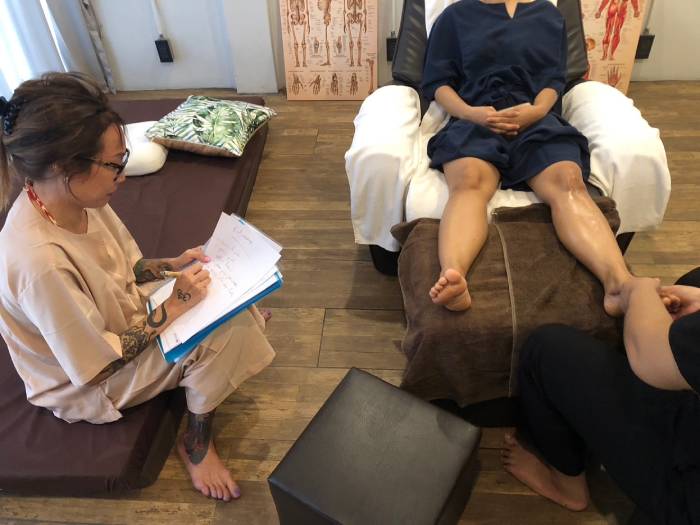
A private Foot Massage and Reflexology course in Bangkok for learning Thai foot massage, reflex zones, wooden tool technique and a complete lower-leg treatment sequence.
Course overview
Included in training
Who can join
Recommended for
Training flow
How the course flows
Interpreter option available · 3,000 THB per student, per half-day Private, in-person training in Bangkok only.
Follow your private training with an interpreter in French, Mandarin Chinese, Japanese, Russian, Spanish, German or Italian.
Interpreter availability and the final schedule are confirmed by the school.
Course FAQ
Frequently asked questions
Answers for Private Foot Massage & Reflexology Course, including level, format, certificate, preparation, booking and training flow.
Who is the Private Foot Massage & Reflexology Course designed for?
The Private Foot Massage & Reflexology Course is designed for Beginners, Spa and wellness professionals, Experienced therapists and Spa owners who want structured, personal training rather than a crowded classroom experience. It works well if you are starting from zero, refreshing an existing skill, preparing to work in a spa, or adding a specialized treatment to your current menu. The focused format lets the instructor understand your background, physical confidence, preferred pace and professional goals before moving deeply into technique. Because the course is practical, you should be comfortable observing, practicing and receiving correction throughout the class. Students often choose this course when they want a clear method, direct feedback and a Bangkok-based learning environment connected to real spa practice.
What will I be able to do after completing the Private Foot Massage & Reflexology Course?
After completing the Private Foot Massage & Reflexology Course, you should understand the purpose, structure and safe delivery of the treatment at a foundation or professional level, depending on the format you choose. The course is built around course introduction, theory and safety principles, instructor demonstration, supervised hands-on practice and feedback and certificate guidance, so the learning is not limited to watching demonstrations. You practice the sequence, learn how each step connects to the next, and receive corrections on pressure, rhythm, body position, hygiene, communication and client comfort. By the end, you should be able to organize a complete treatment flow, explain the main precautions, and continue practicing with a much clearer framework. Like any hands-on therapy, confidence grows with repetition, but the course gives you a serious base for continued development.
How practical is the training during the Private Foot Massage & Reflexology Course?
The Private Foot Massage & Reflexology Course is strongly practical. The instructor does not simply describe techniques; they demonstrate the movement, explain why it is used, and then supervise your own practice step by step. You learn by seeing, doing, adjusting and repeating, which is especially important for bodywork because pressure, angle, rhythm and therapist posture cannot be mastered from theory alone. The training normally includes English or Thai instruction, Senior instructor, Practice model, Foot massage sequence, Reflexology principles, Thai wooden tool technique and Foot charts, with corrections adapted to your body mechanics and learning speed. The goal is to help you feel the difference between a technique that looks correct and a technique that is comfortable, safe and professional for the client.
Do I need previous massage or spa experience before joining?
Previous experience is helpful but not required for most students taking the Private Foot Massage & Reflexology Course. The course page identifies the level as beginner friendly, which means the instructor can adapt explanations and practice details to your background. Beginners usually spend more time on posture, hand placement, treatment order, client communication and basic safety. Experienced therapists can move faster through the fundamentals and use the focused format to refine precision, pressure quality, transitions and professional application. If you already work in wellness, the course can help you compare your existing habits with Thai spa standards. If you are new, it gives you a structured introduction without assuming you already know the vocabulary of massage training.
How does the course cover safety, contraindications and client comfort?
Safety is treated as part of the technique, not as a separate theory note at the end of the Private Foot Massage & Reflexology Course. The instructor explains how to prepare the client, observe comfort, communicate about pressure and recognize situations where a technique should be softened, avoided or adapted. Depending on the course, this may include hygiene, heat control, product use, pregnancy considerations, deep pressure limits, posture issues, sensitive areas or equipment handling. You also learn to protect yourself as the practitioner by using better body mechanics instead of forcing movements with your hands or shoulders. This practical safety layer matters because a good treatment must feel effective while remaining respectful, controlled and appropriate for the person receiving it.
How long is the Private Foot Massage & Reflexology Course and what training options are available?
The available formats are Half Day (3h30), Full Day (7 hours) and Two Days (14 hours). The first listed option is Half Day, 3h30, at 12,000 THB per person. These formats are useful because different students need different depth: a shorter option can introduce the essential method, while longer training gives more time for repetition, correction, questions and treatment flow. The school can confirm the most appropriate option when you explain your background, schedule and goals. For a complete beginner, choosing enough practice time is important because the body needs repetition before movements become natural. For a therapist or spa team, a focused shorter format may be enough for a specific skill upgrade, but extra hours can still be valuable when you want more supervision and confidence.
Is the Private Foot Massage & Reflexology Course taught in English?
Yes. The listed teaching language for the Private Foot Massage & Reflexology Course is English or Thai, so international students can follow the class without needing to speak Thai. The focused teaching setting also makes language support easier because you can slow down, ask for a demonstration again, clarify a safety point or request different wording when a technique feels complex. Massage training is visual and physical as well as verbal, so the instructor combines explanation with demonstration, guided practice and direct correction. This helps students who are learning in a second language because they can connect the words to the movement immediately. If you need a specific language arrangement, it is best to mention it when booking so the school can confirm availability.
Will I receive a certificate after the Private Foot Massage & Reflexology Course?
The Private Foot Massage & Reflexology Course includes School Certificate, provided you complete the selected training format and meet the course requirements confirmed by the school. A certificate is useful as evidence of attendance and study, but the real value is the quality of the training behind it: supervised practice, correction, safety understanding and a treatment structure you can continue developing after the class. For professional or UTTS-linked pathways, the school can explain any assessment, hour requirement or documentation needed before enrollment. If you plan to use the certificate for employment, insurance, a spa menu or a business application, ask in advance what wording appears on the certificate and whether the chosen course format matches your objective.
What should I prepare before attending the Private Foot Massage & Reflexology Course?
Before attending in Bangkok, wear comfortable clothing that allows you to move, stretch, kneel or stand easily depending on the course style. You should also arrive ready to practice, ask questions and receive detailed corrections. If the treatment uses oil, stones, herbs, cups, skincare products, bamboo tools or another material, the school will clarify what is provided and what the session requires. Bring an open notebook or phone notes as well, because small posture cues and sequencing details are easy to forget after a full training day. It is helpful to tell the team about injuries, pregnancy, physical limitations or professional goals before the course begins, because focused training can often be adjusted when the instructor understands your situation early.
How do I book the Private Foot Massage & Reflexology Course and choose my schedule?
To book the Private Foot Massage & Reflexology Course, use the course booking link and share the course name, preferred dates, number of students, language needs and your current experience level. Availability is listed as Flexible private dates, so the school normally confirms the exact schedule directly rather than forcing every student into one fixed public date. The class is taught in Bangkok in a private training environment, with the instructor adapting the rhythm of the day to your goals and practice level. After you send your request, the team can guide you toward the best duration, explain payment or deposit steps, confirm the instructor and answer practical questions about location, preparation or certificate expectations. If you are comparing several courses, describe your main goal first; that makes it easier for the school to recommend the most useful training path.
Can I follow private training with an interpreter?
Yes. For private, in-person training in Bangkok, request French, Mandarin Chinese, Japanese, Russian, Spanish, German or Italian interpretation. The supplement is 3,000 THB per student per half-day: 6,000 THB for one day or 12,000 THB for two days. Availability is confirmed by the school.