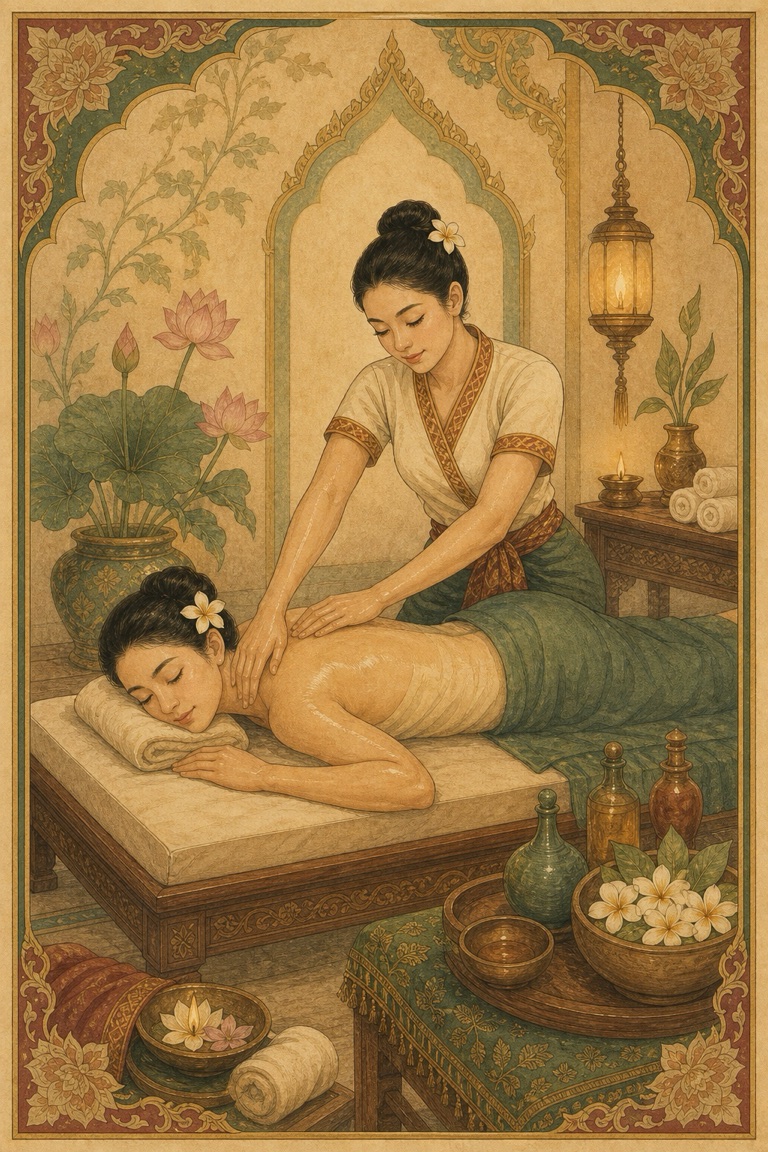
A Thai woman from Nakhon Si Thammarat, Soraya Thaoram, won the gold medal in the oil massage category at the Wellness World Championship 2026 in Bangkok. According to Khaosod English, the competition was held on 18 May 2026 at TK Palace & Convention Hotel and brought together around 200 contestants from 22 countries across facial massage, Thai massage, oil massage and foot massage categories.
For Nuad Thai School students, this is more than a proud national headline. It is a useful case study in what separates a pleasant spa routine from professional massage performance. A championship result does not happen only because a therapist has memorized beautiful movements. It reflects timing, posture, rhythm, pressure control, respect for the client body, and the ability to make oil massage look calm while the therapist is making many technical decisions at once.
The news also matters because oil massage is sometimes treated as the softer or simpler side of spa education. In reality, high-level oil massage is demanding. The therapist must combine a smooth surface flow with clear anatomical intention. Hands, forearms, body weight, draping, product quantity and transitions all have to work together. If too much oil is used, pressure becomes vague. If too little is used, the session loses glide and comfort. If the therapist moves beautifully but ignores tissue response, the treatment becomes performance instead of care.
Why This Championship Result Matters for Thai Wellness Education
International competitions make invisible standards visible. In a normal spa room, the client feels the final result but rarely sees the preparation behind it. In a competition, judges watch body mechanics, hygiene, rhythm, sequence logic, client comfort, professional presence and how safely the therapist adapts technique. That creates a public language for quality.
Thailand has a long wellness identity, but the modern global spa market asks for more than tradition alone. Schools and therapists need to show that Thai training can be culturally rooted, technically precise and internationally understandable. Soraya Thaoram's gold medal is a reminder that Thai massage education can compete on a world stage when it combines heritage with disciplined professional training.
The Khaosod English report notes that the competition used a panel of 30 experts from Thailand and abroad. That detail is important. A therapist who succeeds before an international judging panel must communicate skill without relying on local assumptions. The sequence has to make sense visually and physically. Contact must look confident but not aggressive. The therapist's posture must protect their own body as much as the client's comfort.
Oil Massage Is Flow, But Not Only Flow
Many beginners describe oil massage as a flowing technique. That is true, but it is incomplete. Flow is the visible layer. Under the surface, the therapist is constantly choosing direction, pressure, speed, area, transition and feedback. The best oil massage feels continuous because the decision-making is organized.
In training, students should learn the difference between decorative movement and therapeutic clarity. A long forearm glide can look elegant, but its value depends on angle, tissue contact, speed and how the therapist exits the movement. A kneading technique can feel relaxing, but only when the hands are soft, the wrists are protected and the pressure is not pinching the skin. Effleurage can calm the nervous system, but if the therapist rushes, the client receives speed instead of reassurance.
Championship oil massage also teaches an important lesson about restraint. A strong therapist is not someone who uses maximum pressure everywhere. A strong therapist knows when to reduce pressure, when to broaden contact, when to slow down, and when to avoid a vulnerable area. Professional oil massage should look generous, but it should also be precise.
The Anatomy Behind a Professional Oil Massage Session
Oil massage students need practical anatomy, not abstract memorization. They should understand the skin barrier, superficial fascia, major muscle groups, bony landmarks and common sensitive zones. Anatomy tells the therapist where glide is useful, where pressure should be broad, and where contact must become lighter.
The back, shoulders, hips and legs often receive the longest oil massage work, but each region has different rules. On the back, the therapist needs to respect the spine and use broad contact beside it rather than pressing sharply into bony structures. Around the shoulder blade, slow work can help the client feel spaciousness, but the therapist must avoid forcing the joint. On the legs, pressure should consider varicose veins, bruising, recent injury, swelling, clotting risk and client feedback.
For spa education, this is where oil massage becomes a professional subject. The question is not simply, which stroke comes next? The better question is, what tissue am I contacting, what response do I feel, what has the client told me, and what should I change now? That reasoning protects the client and also protects the therapist from relying on choreography alone.
Product Choice, Skin Safety and Scent Boundaries
Oil massage also depends on product literacy. A championship session may look effortless, but product choice affects grip, glide, skin comfort, scent tolerance and cleanup. Students should know the difference between carrier oils and essential oils, and they should never treat aromatherapy as a place for exaggerated medical claims.
Responsible training asks simple but important questions before a session: Does the client have allergies? Is the skin irritated, broken or inflamed? Is the client pregnant, scent-sensitive, asthmatic or prone to headaches? Has the client used skincare products or medication that might change skin sensitivity? These questions do not make the treatment less luxurious. They make it safer and more professional.
Essential oils, when used, should be diluted conservatively and explained honestly. The goal is to support atmosphere and comfort, not to promise cures. A therapist should be able to create a beautiful oil massage even with a simple neutral carrier oil. Skill comes first; scent is only one supporting layer.
What Students Can Learn From a Gold Medal Performance
A competition headline can inspire students, but inspiration needs to become practice. The first lesson is body mechanics. A therapist who wants a long career cannot work from hand strength alone. They need stance, breath, weight transfer, table height awareness, soft knees and relaxed shoulders. In oil massage, the therapist's body should move as one unit so the client receives stable pressure instead of uneven effort.
The second lesson is sequencing. A good oil massage session has a beginning, middle and closing. The beginning establishes safety and rhythm. The middle develops depth, detail and area-specific work. The closing returns the nervous system to calm and gives the client a sense of completion. Without sequence logic, even beautiful strokes can feel random.
The third lesson is feedback. In class, students must learn to ask clear questions without breaking the atmosphere. A simple pressure scale, a check-in after the first deeper movement, and careful observation of breathing or guarding can change the quality of the whole session. Professional touch is never separate from communication.
A Practical Training Matrix for Oil Massage Students
| Training layer | What it means | Student cue |
|---|---|---|
| Flow | Continuous rhythm, calm transitions and a session that feels coherent from start to finish. | Do not rush the space between techniques. |
| Anatomy | Skin, fascia, muscles, joints, bony landmarks and sensitive areas guide pressure decisions. | Name the structure before increasing pressure. |
| Product safety | Carrier oil, essential oil dilution, allergies, scent sensitivity and hygiene shape the treatment plan. | Choose simple products when client history is unclear. |
| Body mechanics | The therapist uses posture and weight transfer instead of wrist and thumb strain. | Move from the feet and hips, not only from the hands. |
| Professional scope | Massage supports comfort, relaxation and body awareness; it does not diagnose or cure disease. | Use wellness language and refer medical concerns. |
How Nuad Thai School Connects News to Training
At Nuad Thai School, a story like this belongs naturally beside the Private Aroma Oil Massage Course. Students need to see that oil massage is not only a spa menu item. It is a learnable professional discipline with technique, hygiene, client communication, rhythm, product control and safety boundaries.
The same news also connects to broader Thai massage education. Students who study Private Thai Massage learn body mechanics, pressure awareness and respectful contact. Those foundations carry into oil massage, even though the format is different. Traditional Thai massage may use mat-based pressure and assisted stretching, while oil massage uses glide and draping, but both require listening hands and disciplined posture.
For international students coming to Bangkok, the championship result is also a useful signal. Thailand is not only preserving massage heritage; it is participating in the global wellness conversation. A student who trains here can learn cultural context, spa etiquette, body mechanics and modern professional expectations in the same environment.
From Celebration to Professional Standard
It is easy to read a gold medal story as a feel-good moment and move on. A better response is to ask what standard the achievement points toward. Soraya Thaoram's result shows that oil massage can be judged, refined and recognized internationally. It shows that a therapist from a Thai province can bring local training and personal discipline onto a global stage. It also shows students that excellence is built from repeated correction, not from quick imitation.
For schools, the lesson is equally clear. Articles about competitions should not become empty publicity. They should help students understand what excellence is made of: safe touch, clean technique, thoughtful product use, confident body mechanics, client respect, and the humility to keep learning. When those habits are trained every day, a massage routine becomes a professional language.
FAQ
What happened at the Wellness World Championship 2026?
Khaosod English reported that Soraya Thaoram from Nakhon Si Thammarat won gold for Thailand in the oil massage category at the Wellness World Championship 2026 in Bangkok. The event included around 200 contestants from 22 countries.
Why is this relevant for massage students?
The result highlights the professional skills behind oil massage: flow, pressure control, anatomy, product safety, client communication, posture and disciplined sequencing. These are all teachable skills, not simply natural talent.
Is oil massage easier than traditional Thai massage?
No. Oil massage may look softer, but it requires precise control of glide, pressure, draping, hygiene and client comfort. Traditional Thai massage and oil massage use different methods, but both require serious training.
Can oil massage be described as medical treatment?
No. It should be presented as wellness and spa education. A therapist can discuss relaxation, comfort and body awareness, but should not diagnose conditions or promise medical outcomes.