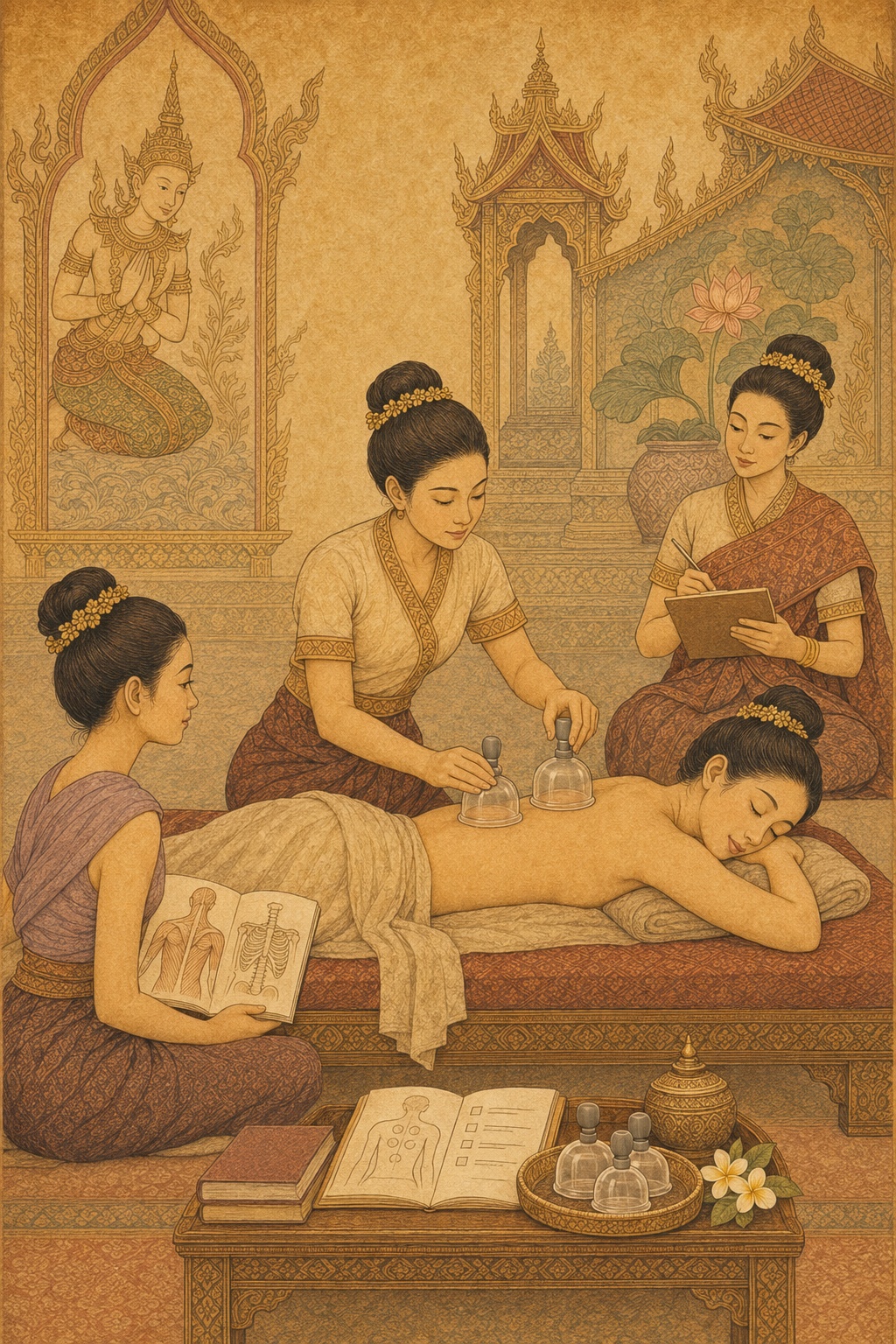
A cup on a tray can tell you something about a student's judgment before it touches anyone. Ask the student to explain what would make them leave it there. “If the person says no” is a good start. A better answer also considers what the person expects, whether the skin is suitable, how the equipment was prepared, and whether the student could release the cup promptly if the sensation changed. Those decisions are easier to miss than a crooked row of cups. They are also better reasons to seek supervised training than the promise of making a perfect circle on someone's back.
This guide concerns dry cupping with suction equipment on intact skin in a supervised massage classroom. It does not teach skin piercing, bloodletting or the use of flame. Its practical question is how to tell when a student can make and explain a sound decision. A comfortable volunteer and a tidy tray are useful starting conditions; neither establishes that a learner is ready to work independently.
What is a cupping student entitled to claim?
In a neck pain review published online on 9 May 2026, researchers pooled nine randomized trials involving 401 adults with chronic neck pain. The authors found improvements in pain and disability, with more consistent results for function than for pain. The 2026 neck pain review is useful precisely because it names the population: adults with symptoms lasting at least three months. A finding in that population does not identify a safe place to put a cup on a healthy classmate, or tell us what suction that person will find comfortable.
A BMJ Open review asked a broader question about chronic musculoskeletal pain. Ten trials compared different forms of cupping against sham treatment, waiting or rest. Immediate pain scores favored cupping on average, but results varied substantially between trials. The pooled disability result did not show a clear benefit. A waiting list cannot account for attention and expectation in the same way as a credible sham. Also, just one included study used moving cupping. A result across all those interventions cannot tell an instructor that a moving cup should travel farther or faster.
Two low back pain experiments make the problem especially clear. In the smaller sham-controlled trial, 38 people were randomized and 37 completed the study. Five sessions produced lower pain scores than sham at the end of treatment and at follow-up; the difference in disability was no longer clear at follow-up. Most participants were young women. In the larger sham-controlled trial, 90 adults were randomized to weekly dry cupping or sham for eight weeks. There was no worthwhile advantage in pain or function. Neither experiment measured whether a student had learned to screen someone or stop appropriately.
Different protocols, comparators and participants can produce different estimates without either study having to be dismissed. The defensible answer to a prospective client's question is that some clinical studies find short-term differences and others do not. One can explain the physical action without predicting the person's outcome. The US National Center for Complementary and Integrative Health describes suction, temporary marks and possible harms. It gives no basis for interpreting the color of a mark as a measure of toxins removed.
For a reader interested in this distinction, the Private Cupping Therapy Course at Nuad Thai School is a place to discuss how much practice you want in explaining a technique before applying it. Try describing a cup without using the words “cure,” “release toxins” or “fix.” Then explain how a person can decline the cup and still take part in the lesson. If either explanation feels harder than placing the equipment, you have identified a useful training goal.
Assess the encounter from both sides of the table
Start with the proposed goal in the person's own words. “I want to learn what the sensation is like” makes a different request from “Can you treat the pain that woke me last night?” A student can acknowledge the second question without undertaking a clinical assessment. Listen, explain the limits of the lesson and involve the instructor before deciding whether any practice is appropriate. Consent to a general massage does not automatically include suction, marks, a particular body area or a student observer.
Next ask what the person needs to know to decide freely. Explain what will be uncovered, how the rest of the body will be draped, and that a temporary visible mark is possible. Ask about previous reactions, medications that might affect bleeding and skin changes. Do not ask a person to stop a prescribed medicine to take part. A student who cannot interpret an answer should bring it to the instructor privately. A person who does not want marks has already supplied enough information to decline the exercise.
The cupping chapter of the Clean Needle Technique Manual recommends checking medication and bleeding history, observing the condition of the skin and maintaining a clean field. It advises against cupping over active lesions or damaged skin. This is professional safety guidance written for a particular clinical discipline, not Thai licensing policy. Its useful classroom implication is concrete: a cup set aside because its cleaning history is unknown stays out of use. Dry cupping does not intentionally break the skin, but the equipment can still be contaminated.
During a supervised demonstration, position yourself where you can see the rim and hear the volunteer. Notice how the instructor distinguishes the seal holding from the person tolerating it. Those are separate observations. A cup that stays in place may still pinch. Watch how the instructor responds to that report and releases the seal without pulling the skin up with the cup. Practice the release under instruction before attempting to manage several cups or to work while looking elsewhere.
A moving cup presents a second task: managing sideways drag while maintaining contact. If it catches, the relevant skill is recognizing the changed sensation and stopping. Pulling harder to finish the intended path defeats that purpose. Ask the instructor to observe one short movement and tell you what your other hand and eyes were doing. You may discover that while concentrating on the rim you stopped checking the person's face, or left a towel unsecured. That kind of correction is hard to obtain from a diagram.
Choose the exercise that answers the learning question
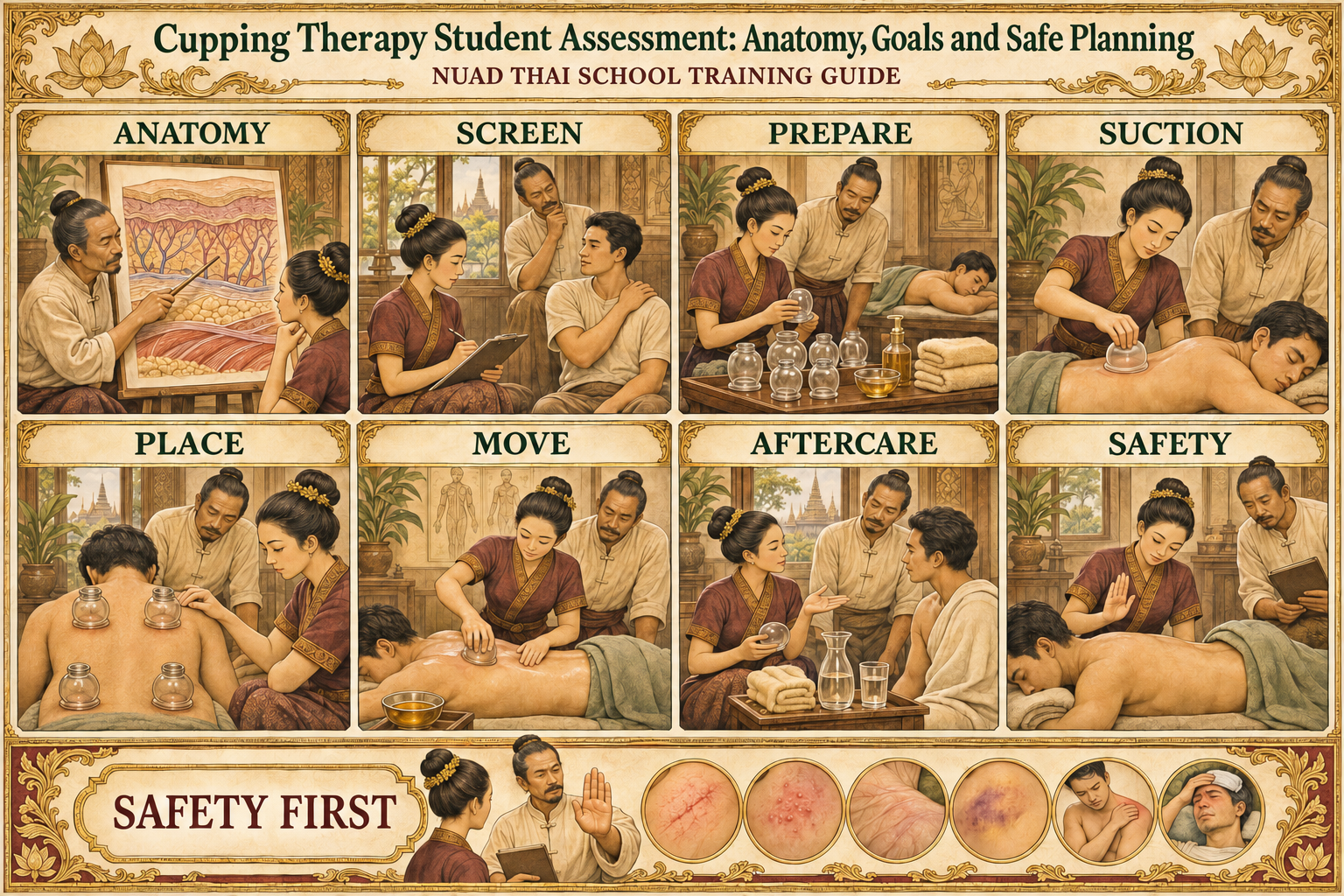
The choice is not a ladder from weaker to stronger. Static and moving work pose different problems; observation or no application may be the best exercise of the day. Use the table to discuss a choice with the supervisor. It is a guide to learning decisions, not a time or pressure prescription.
| Learning decision | What the student must notice | What the observer can check |
|---|---|---|
| Keep a cup stationary | A seal can hold even when the person wants it released. | Does the student remain attentive and act on feedback? |
| Practice one supervised glide | Drag can change even across a short path. | Does the student stop when the rim catches instead of forcing the movement? |
| Rehearse without skin contact | The learner is still unsure how to operate the release. | Can they explain the device and demonstrate its controls to the instructor? |
| Defer application | Consent, skin suitability or equipment history is uncertain. | Does the student give a clear reason and offer observation without pressure? |
At the end, ask the volunteer and observer separate questions. The volunteer can tell you when a sensation changed and whether they felt able to say so. The observer can tell you how promptly you reacted. Agreement between the two is useful, but disagreement may teach more. If the observer saw an apparently smooth movement while the volunteer felt a sharp tug, the next exercise should examine that moment rather than attempt to reproduce the appearance.
Four mistakes an instructor can actually observe
The first is using a mark as the score. A strong circle photographs easily; an appropriate refusal leaves nothing to photograph. Ask for a verbal account instead: what did the person agree to, what was checked and why did you continue or stop? A student who cannot answer has not demonstrated those skills, whatever the skin looks like afterward. Never use a photo of a volunteer as a substitute for their permission to take or share it.
The second is asking a leading question. “That's fine, isn't it?” offers little room for disagreement. A more useful invitation is “What do you notice now?” followed by space to answer. Agree on a stop signal that works in the person's position and language. If you cannot communicate reliably, do not use the cup. Silence from someone lying face down is a poor substitute for a check.
The third is mixing used equipment with the clean set. A cup can look clear while its handling history is unknown. Identify where used items go before the exercise begins. Follow the applicable reprocessing procedure and manufacturer instructions; if the required process cannot be confirmed, do not share the device. Pouring more oil or wiping the rim with a towel does not resolve the uncertainty.
The fourth is recording an interpretation as an observation. “Dark mark; deep blockage cleared” combines a visible finding with a diagnosis the student did not establish. A useful practice note describes what was done, where, how the person described the sensation, why the exercise ended and what advice was given. The next instructor can then judge the decision without having to accept a speculative mechanism.
Two hypothetical classroom decisions
Hypothetical scenario: a volunteer asks for a visible circle
A volunteer requests a mark like one seen in a sports photograph. While discussing it, they mention recent unexplained bruises and cannot remember the name of a new medicine. The student has already arranged the tray and wants to finish the assignment. This is a test of whether the student can change the assignment.
Leave the cup on the tray, explain why the new information matters and ask the instructor to switch the exercise to observation. Unexplained bruising is a reason to seek appropriate medical advice, not an opportunity to guess which medication is responsible. The volunteer can practice asking screening questions instead. An observer could give credit for the decision even though no cup touched the skin.
Hypothetical scenario: the rim catches during a glide
In a supervised exercise on suitable intact skin, a volunteer who agreed to a moving cup says the sensation has changed from gentle pulling to a pinch. The student can see that the seal still holds. A classmate suggests finishing the stroke since only a short distance remains.
Stop the movement, release the seal under supervision and check the person's comfort and skin before considering any further activity. Consent before the stroke does not oblige the volunteer to accept the rest of it. The instructor can examine the student's grip, the product and the direction of travel without repeating the stroke on that person. The useful assessment is whether the student acted on the report before trying to troubleshoot the equipment.
Where a practice assessment ends
A mark cannot tell you what happened in deeper tissues or whether a condition improved. Persistent discoloration, blistering, burns or signs of infection are not proof of successful treatment. Stop and obtain appropriate medical advice for an unexpected or worsening reaction; urgent symptoms need urgent assessment. In teaching, describe the site and what the person reports without telling them what condition they have. Explain that they can tell a health professional when and where cupping took place.
The absence of serious events in a small set of trials cannot establish that harm is impossible in a different person or setting. The converse also matters: a list of possible side effects does not tell us how frequently they occur in a particular school. Neither the clinical trials nor the course page establishes the safety of a particular cup, the legal scope of practice in your country or your readiness to work without supervision.
Which course gives you the feedback you need?
Nuad Thai School describes a private Bangkok course with instruction normally in English or Thai. The published curriculum includes both static and moving cupping with supervised practice and skin-response checks. The school lists a practice model and feedback on the student's handling of the equipment. These details matter if your question is whether someone will observe your own hands after the demonstration. Ask about your particular goal when arranging dates, especially if you need an interpreter; the school confirms that arrangement and the schedule directly.
The course page welcomes beginners as well as experienced spa professionals. A beginner might ask to spend more time on positioning, consent and a controlled release. A therapist adding cups to an existing service may need more feedback on the transition between hands and equipment: what changes in the intake conversation, and what happens if someone chooses hands only? Describe that distinction in your booking request. Include your experience, preferred dates, number of learners and language needs so the school can advise on fit.
For someone who wants better control of manual pressure and forearm positioning, the Private Deep Tissue Massage Course offers a different practice problem without the need to form a seal. If the goal is handling equipment while monitoring comfort, the Private Hot Stone Massage Course develops that habit around stone temperature and handling. Heat and suction require different safeguards. Neither complementary program is a recommendation to combine those exposures on the same patch of skin.
FAQ
Does darker skin discoloration mean the exercise worked better?
No. The color gives you no validated scale of therapeutic benefit. A more informative assessment is whether the student explained the possibility of marks, respected the person's preference and checked the area afterward. Someone may understand the explanation perfectly and still prefer not to have a visible mark. That preference is enough to choose another exercise.
Can I use the times or number of sessions in a trial as my practice plan?
Those numbers describe what the investigators tested in a selected group. They are not individual safety limits or an instruction to repeat a trial on a volunteer. Ask the instructor what observations would make them stop an exercise early and how the equipment is meant to be used. A timer cannot answer either question.
What should I bring up if I have never worked in a spa?
Tell the school you are starting from the beginning. Ask how much time is available for preparation, communication, handling a cup and repeating a correction. The course description says prior experience is helpful but generally not required. Confirm the format that fits you before making travel arrangements; an available date is something to establish directly with the school.
What if I can follow a demonstration but cannot explain a stop signal in Thai?
Tell the school which language you need when asking for dates. Watching a movement may help you understand it, but the person receiving it needs a reliable way to express discomfort immediately. Rehearse that conversation before doing hands-on work. An interpreter is an arrangement to confirm in advance, not something to assume on arrival.
What is a reasonable next step after a supervised class?
Keep a practice record of decisions you can explain, including occasions when you chose no cup. Ask for feedback on the skill that remains least reliable. Completing a class does not settle local professional or insurance requirements. If your goal is supervised dry cupping in a massage setting, use the Private Cupping Therapy Course at Nuad Thai School to describe your background, discuss fit and request a place.
Sources and References
- Effect of cupping therapy on chronic neck pain: a systematic review and meta-analysis of randomized controlled trials — Journal of Back and Musculoskeletal Rehabilitation
- Effects of cupping therapy on chronic musculoskeletal pain and collateral problems — BMJ Open
- Effect of dry cupping therapy on pain and functional disability in persistent non-specific low back pain — Journal of Acupuncture and Meridian Studies
- Dry cupping therapy is not superior to sham cupping to improve clinical outcomes in people with non-specific chronic low back pain — Journal of Physiotherapy
- Cupping — US National Center for Complementary and Integrative Health
- Clean Needle Technique Manual, seventh edition: cupping recommendations — Council of Colleges of Acupuncture and Oriental Medicine
- Private Cupping Therapy Course — Nuad Thai School