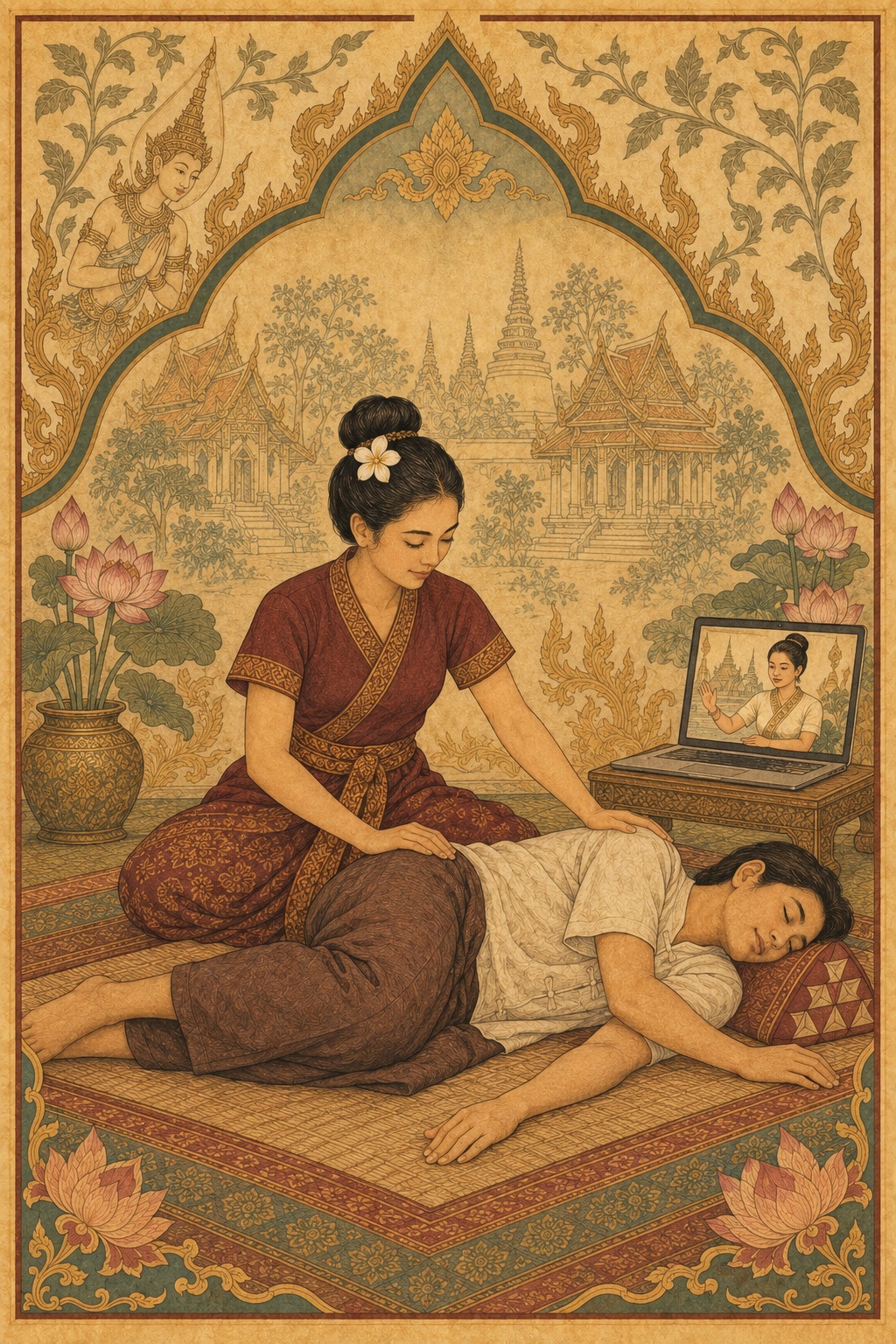
A massage demonstration can look clear on a laptop while leaving the most important learning question unanswered: can the teacher see what you are doing well enough to correct it? A close-up reveals hand placement but may hide a rounded back. A wide view reveals posture but may conceal a misplaced thumb. Neither view allows the teacher to feel pressure through the screen.
Live online massage training can be useful when the lesson is designed around those limits. Its value comes from a cycle of demonstration, observed practice, specific correction and another attempt. This guide explains how to prepare that cycle, compare learning formats and decide which skills need an in-person follow-up. It concerns education for appropriate practice partners, not remote diagnosis or treatment of medical conditions.
What the research can tell a prospective student
Research on online health-profession education gives a mixed picture because it measures different things. A 2015 systematic review of physiotherapy education included 22 articles and 1,694 participants. It found useful roles for online resources, including practical learning and reflection, but the varied methods prevented a meta-analysis. Its search ended in 2013. These findings support thoughtful use of digital resources; they do not establish that a live massage course is equivalent to hands-on teaching.
A 2023 study of manual-therapy students illustrates the difficulty. Its observational part included 63 students and found no statistically significant performance differences between cohorts. In a randomized part involving 56 students, the lecturer-and-peer group performed better than the video-and-mannequin group. However, both instruction and the practice surface changed, and the video group lacked feedback. This was a single university studying immediate performance, not long-term massage competence. The study did not test live interactive massage tuition with a local human practice partner.
The practical question is therefore what the teacher observes and what the student must demonstrate again. Watching, understanding and performing a massage movement are different achievements. A learner who can explain a movement may still need correction when positioning their body or responding to another person's comfort.
The WHO's 2010 Nuad Thai training benchmarks address professional therapeutic practice and include anatomy, communication, contraindications and supervised clinical experience. They explicitly distinguish that scope from massage for health and relaxation. They are a historical training framework, not an endorsement of a particular school, an online-course assessment or a statement of today's licensing requirements. Their useful lesson here is that competence involves decisions and boundaries as well as a remembered sequence.
Nuad Thai School's online course page describes a live instructor demonstrating with a practice model in Bangkok. The page also describes real-time correction while the student practices locally. If that format matches your aim, use the Online Massage Course enquiry to discuss your existing experience, intended technique and practice setup before selecting a lesson.
Build a lesson the instructor can actually observe
Prepare the person, space and connection
Agree on a suitable practice partner with the school before the session. Someone being present in your home does not automatically make them an appropriate model. Explain that you are learning, what contact is proposed and how they can stop. Share relevant concerns privately with the instructor in advance; do not turn an unexpected symptom into an improvised classroom challenge. If suitability is uncertain, use the time for observation and discussion until a safe plan is agreed.
Set up a stable mat or treatment surface appropriate to the selected lesson, with room to move without stepping over cables. Place clean materials within reach and keep devices away from oils and water. Test the connection from the actual practice area, with the camera in its teaching position. A successful call from a desk says little about the view from the floor. Agree what happens if either picture or sound disappears: stop the hands-on activity first, then restore communication.
A practice partner's agreement to massage is separate from agreement to filming or sharing recordings. The Chartered Society of Physiotherapy's consent guidance treats consent as ongoing and requires explicit explanation of recording uses in its professional context. For a class, agree who can watch, whether anything will be recorded, where it will be stored and how long it will be retained. This is a practical privacy discussion, not a claim that one country's clinical rules govern every international lesson.
Choose views for specific learning questions
Start with a wide view that includes your shoulders, elbows, hands, stance and the relevant part of the practice partner. Ask the instructor to confirm the view before contact begins. Then test a closer angle for hand placement. A second camera can help, but a single stable camera moved between attempts can be more useful than two poorly placed devices. Stop the technique before moving equipment; do not hold a phone while attempting two-handed bodywork.
A camera can show visible positioning and movement, but it cannot directly transmit the pressure felt by the practice partner. Use clear comfort questions and the partner's responses alongside the teacher's observations. Do not infer a safe force from how effortless the teacher looks. Avoid escalating pressure just because a movement seems small on screen. When the instructor cannot confidently assess an important detail, reposition, simplify or defer the task.
Sound deserves its own rehearsal. The instructor should hear questions and the practice partner's responses without the student leaning away from the working position. If you need captions, slower explanations or repeated terminology, discuss this before booking. W3C's live-caption guidance explains how synchronized text supports access to audio information, while distinguishing broadcasts from two-way calls. Captions should not cover the hands being demonstrated. Do not assume a platform's automatic transcription will render unfamiliar anatomical terms correctly.
Use a small, repeatable feedback cycle
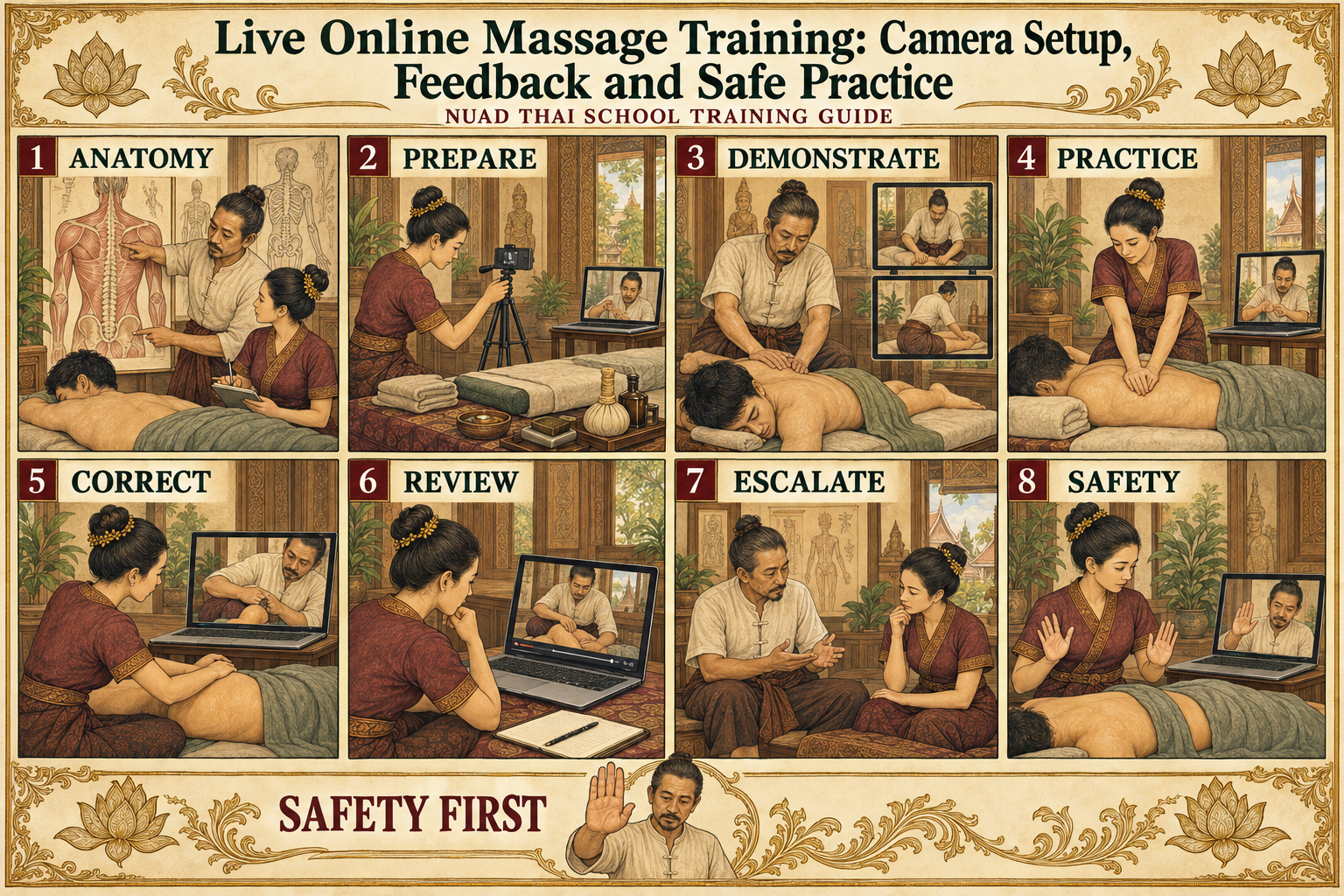
A useful practice cycle is: watch one short component, describe the intended action, perform it while observed, receive one clear correction, then repeat. This is a proposed study method, not a promise about a fixed school timetable. Ask the instructor to identify the priority correction rather than collecting a long list that you cannot apply at once. For example, changing the camera angle may need to come before correcting a wrist position that remains hidden.
Record the learning issue in plain language: what the teacher noticed, what you changed and what needs checking next time. Separate a movement completed with prompts from one repeated without prompts. Ask for a later repetition after another activity, rather than assuming one improved attempt means the skill is established. If replay is available with consent, review the difficult transition and then arrange another observed attempt; repeated viewing alone does not test execution.
Choose the format around the skill you need
Start with the task rather than the convenience of the delivery format. Do you need to remember an order, understand a concept, receive feedback on a familiar movement or learn unfamiliar tactile skills? The table is a decision aid for discussing a training plan. It does not rank every provider or imply that all online lessons have the same design.
| Learning need | Useful format | What to verify | Remaining limitation |
|---|---|---|---|
| Review a familiar sequence | Approved recording alongside practice notes | Clear views and permission to replay | No immediate correction while watching alone |
| Improve visible posture or pacing | Live online lesson with observed repetition | Teacher can see the relevant joints and hear the partner | Visual feedback does not transmit touch |
| Learn unfamiliar pressure or complex positioning | Discuss an in-person foundation or follow-up | Direct supervision and appropriate practice partners | Attendance alone still does not prove competence |
| Train a spa team on a defined routine | Live group teaching with individual observation time | Each learner receives feedback, not only the demonstrator | A crowded camera view can hide errors |
| Prepare for professional practice | A broader assessed pathway suited to local requirements | Curriculum, supervised practice and assessment expectations | A short module is not automatic permission to practise |
For a team, appointing someone to handle the camera can protect practice time, but that person should not be treated as a qualified local supervisor merely because they manage the call. Ask how individual attempts will be observed. If one student performs throughout the lesson, the rest may have observed useful teaching without having demonstrated their own skill.
Common mistakes that make live feedback less useful
Framing only the hands. The teacher may see contact but miss an unstable stance or strained shoulder. Begin wide, then move closer for a specific question. Copying the teacher's pace immediately. An experienced demonstration can conceal small transitions. Request a slower component and describe what you think happened before repeating it.
Using discomfort as a measure of progress. The NCCIH massage overview reports rare serious adverse effects and advises against delaying medical attention for a problem. Massage is not risk-free, and stronger pressure is not a reliable sign of better learning. Stop an uncomfortable or uncertain exercise and discuss it; do not ask a practice partner to tolerate pain for the sake of finishing a sequence.
Continuing through a connection failure. Once the instructor loses the relevant view or cannot hear the partner, supervision has changed. Pause rather than guessing the missing instruction. Saving everything without a privacy plan. Optional recording is a learning tool only when everyone understands the arrangement. A private lesson should not become a public clip by default.
Two hypothetical classroom decisions
Hypothetical scenario: the wrist disappears from view
A beginner has positioned a laptop near the mat. The teacher can see the student's upper body but cannot distinguish the wrist angle during a simple, previously demonstrated contact. The partner reports comfort, and the student wants to continue because the movement feels easy. Comfort matters, but it does not answer the teacher's observation problem.
The student stops contact, moves the camera to show the wrist and stance, and repeats only after the instructor confirms the view. The next task is an observed repetition with the agreed correction, not an increase in force. The useful lesson is to repair the information gap before interpreting apparent confidence as progress. This is an invented teaching example, not a reported student outcome.
Hypothetical scenario: a spa team requests a harder technique
A team joins a live refresher and asks to add an unfamiliar, demanding stretch. Their camera shows the room well, but the instructor cannot assess each participant's handling or each partner's suitability. The request also extends beyond the agreed practice plan. A more ambitious demonstration would not resolve those missing observations.
The instructor and team keep the session within the agreed low-risk material and arrange an in-person discussion before attempting the unfamiliar stretch. The remaining time can be used to review communication, positioning and questions about the next course. This hypothetical decision illustrates a useful boundary: the ability to stream a movement does not establish that everyone should practise it remotely.
What this guide and a video call cannot establish
The research reviewed here does not directly test Nuad Thai School or establish clinical outcomes from its online course. The review covers older, varied educational technologies; the manual-therapy trial concerns physiotherapy students and different practice conditions. Neither provides a reliable percentage of massage skills that can be learned online. We therefore make no numerical promise about learning speed, competence or results.
The preparation and feedback suggestions in this guide are educational recommendations drawn from those limits. They are not a validated assessment instrument or a substitute for the school's individual evaluation. Traditional concepts may be taught as part of Nuad Thai heritage; understanding that tradition does not by itself verify a biomedical mechanism or authorize treatment of disease. Medical questions require an appropriately qualified professional.
Some tasks may be suitable for remote observation after discussion; others require closer supervision or should be deferred altogether. Tell the school about the learner's experience and the proposed partner's relevant limitations privately. If your intended work involves a regulated profession, check the requirements with the relevant authority and insurer before relying on a course certificate. The right training decision can be a sequence of learning stages rather than one booking.
How Nuad Thai School's live format may fit your plan
The official online course page lists English or Thai as the teaching languages. It describes flexible online dates arranged with the school, and says the selected course determines the tuition format. It also identifies optional recording or professional streaming support. These are concrete matters to confirm for your session; they are not a guarantee that every requested date, technique or recording arrangement is available.
A beginner can ask for an appropriate foundation with enough time to practise and receive correction. An experienced therapist may have a narrower question about posture, transitions or a selected routine. A spa team should explain how many people need individual feedback and what equipment is available. In each case, send the intended course, experience level, dates and time zone, language, partner arrangements and any access needs. Ask what preparation is required before purchasing materials.
Two complementary paths are worth discussing. The Private Thai Massage Course offers an in-person route to work on cultural foundations, body mechanics and full-body practice; it is a logical follow-up when touch and positioning need closer correction. The Professional Thai Massage Course is relevant when your aim extends to a broader training pathway, where the school can explain practical work and completion requirements. Neither should be chosen solely because its title sounds more advanced; compare its content with the gap you need to address.
To take the next step, discuss your live online massage training plan with Nuad Thai School. Ask which parts can be observed reliably from your location, what you should demonstrate by the end and when an in-person follow-up would be more useful. A well-matched course should give you a clear next practice task as well as a lesson to attend.
FAQ
Can I join if I am a complete beginner?
The course page describes the format as beginner friendly. Explain that you are starting from zero so the school can discuss suitable content, pace and partner arrangements. Beginner access does not mean every advanced technique is appropriate remotely. Ask for a clear first learning objective and how your attempt will be observed.
Do I need a practice partner and two cameras?
Confirm the partner requirement for the selected session with the school. Its instructor has a practice model in Bangkok, which does not supply someone at your location. Two cameras are not a universal requirement stated on the page. The important question is whether your setup shows the details needed for the agreed lesson.
Can the instructor correct pressure through video?
The school describes guidance on pressure, posture and rhythm. Video can support discussion and visible correction, but the teacher cannot directly feel your contact remotely. Your partner's responses and the instructor's judgment matter. If reliable assessment is not possible, reduce the task to suitable material or discuss an in-person option.
Are recordings, dates and tuition fixed?
The page presents recording support as optional and schedules as flexible arrangements to confirm. Tuition depends on the chosen course and setup. Request a clear description of what your booking includes, including any recording access or streaming support, rather than assuming all services are bundled into one standard package.
Will a certificate let me work professionally everywhere?
The school describes a training certificate subject to the selected format and completion requirements. It is not a promise of universal licensing, insurance acceptance or employment. Explain where and how you intend to work, request the relevant course documentation and check recognition with the authority or organisation that will assess it.
Sources and References
Sources checked on 2 November 2026. The two research papers were read in full, including methods and limitations. The WHO document is a professional training framework; CSP and W3C supply professional and accessibility context. Their inclusion does not imply endorsement of the school.
- Luedtke and colleagues: Effectiveness of online teaching on practical manual therapy skills (2023).
- Mącznik, Ribeiro and Baxter: Online technology use in physiotherapy teaching and learning, systematic review (2015).
- WHO: Benchmarks for training in Nuad Thai (2010), including the full downloadable document.
- NCCIH: Massage Therapy: What You Need To Know.
- Chartered Society of Physiotherapy: Consent and physiotherapy practice, reviewed July 2025.
- W3C: Understanding live captions, accessibility guidance.
- Nuad Thai School: current Online Massage Course details; Private Thai Massage Course; Professional Thai Massage Course.