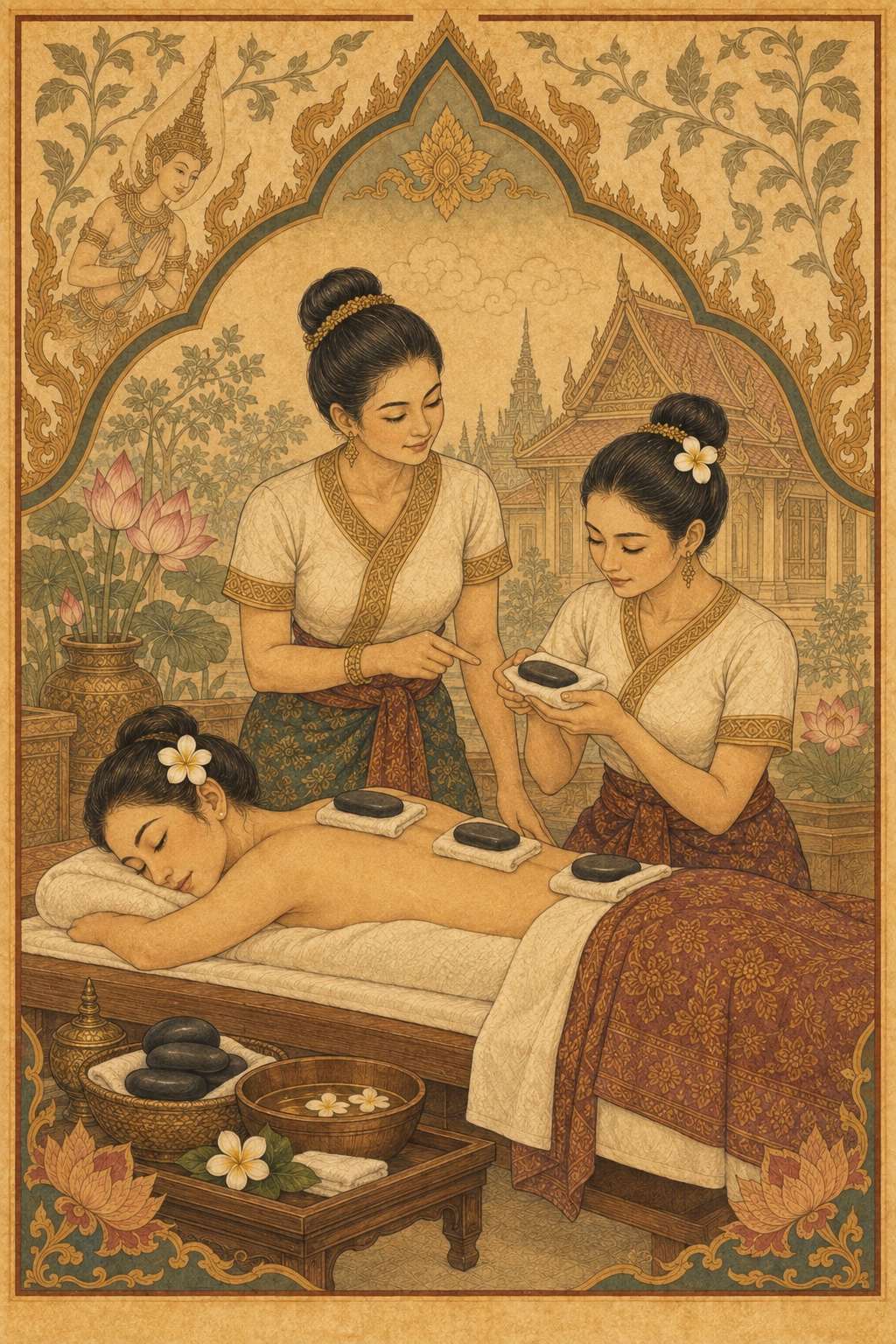
A hot stone massage can look composed while the practitioner is making several decisions at once: whether heat is appropriate, whether the equipment is ready, whether a towel has shifted, and whether a quiet client is genuinely comfortable. Learning the sequence is only one part of the job. The more useful training question is: can you recognise a change, explain its significance and respond before continuing?
This guide examines what supervised hot stone practice should test. It builds on the school's equipment and heat-control introductions with an assessment-focused approach: interpreting evidence, comparing learning routes, rehearsing interruptions and checking your own decisions. The classroom exercises proposed here are educational examples, not reports of observed lessons or a substitute for practical instruction.
What the evidence can—and cannot—tell a student
The World Health Organization's burns fact sheet, dated 21 October 2026, emphasises prevention through safer environments, equipment, education and timely care. That is relevant to any training room using heated objects. It is not new evidence that hot stone massage works, and population-wide burn statistics cannot tell us how often injuries occur during spa treatments.
A Cochrane review published in 2006 included nine trials with 1,117 participants. It found limited evidence of small, short-term improvements with heat wraps in acute or subacute low-back pain. The search ended in October 2005. We read the published abstract and plain-language summary, not the full review. Heat-wrap findings do not establish that hot stone massage treats back pain. The device, exposure, population and outcome all matter when transferring a result.
There is also directly relevant original research. A 2019 randomised trial by Ghavami and colleagues enrolled 60 men receiving maintenance haemodialysis at one hospital. Thirty received 12 hot-stone sessions over four weeks alongside routine care; thirty received routine care alone. Self-reported sleep scores improved in the intervention group. We read the full article, including its methods and limitations. There was no sham or attention-matched comparison, the sample was small and male-only, and the outcome was a questionnaire. This trial does not establish an insomnia treatment for the general spa population. Its chakra terminology describes the authors' chosen protocol, not a demonstrated anatomical mechanism.
The practical consequence is a disciplined explanation to a prospective client: the service offers a warm, carefully adapted massage experience; medical symptoms need appropriate assessment. A student should be able to separate a research finding from a sales promise. Ask what was actually compared, who participated, how improvement was measured and whether the result applies to the person in front of you.
Turn the lesson into observable decisions
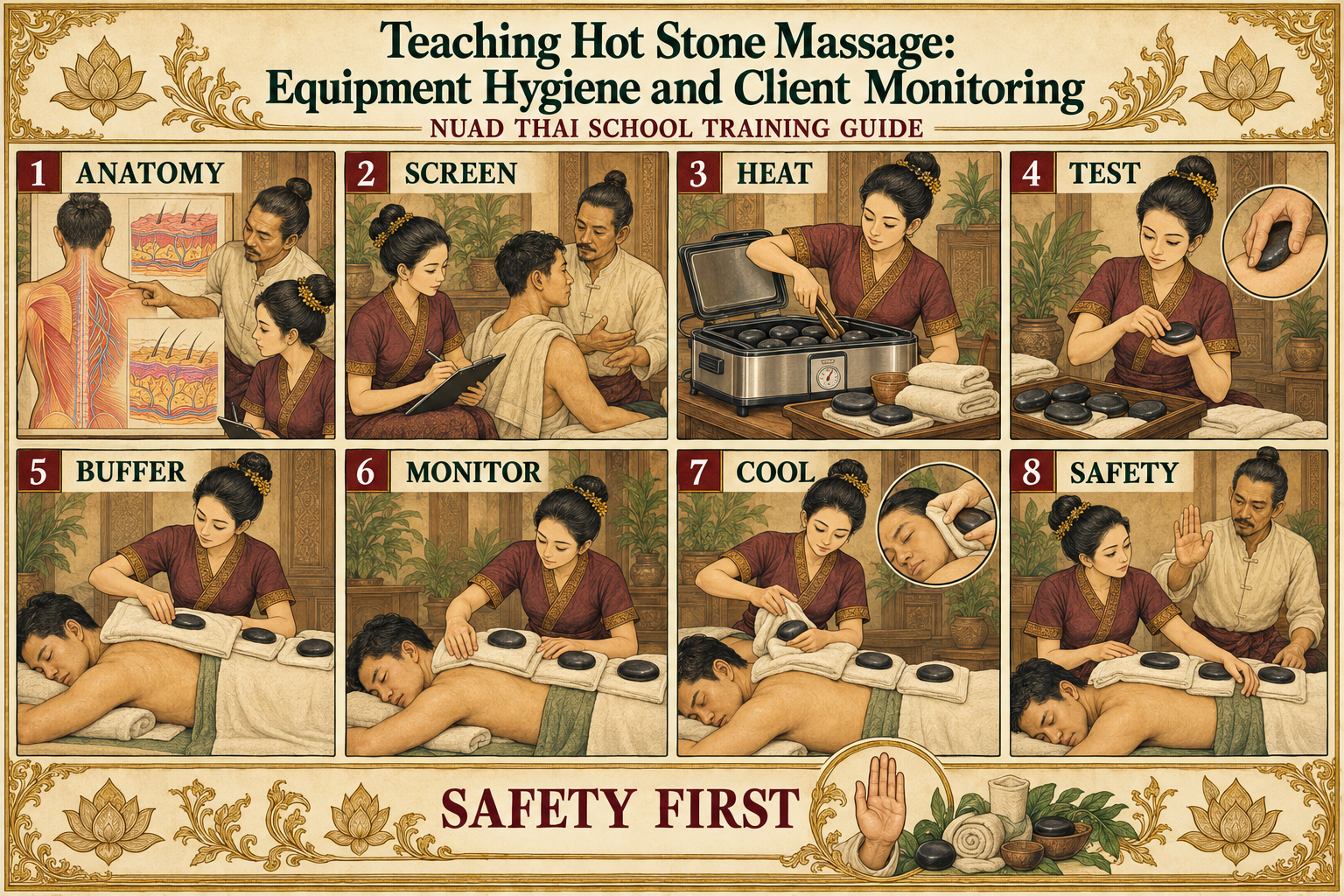
The following sequence is a proposed learning framework. It helps you discuss supervision with an instructor without pretending that reading an article qualifies you to deliver heated treatments. Start with an unheated rehearsal. Add equipment and heat only within the instructor's protocol, with an appropriate practice model and a clear way to stop.
1. Explain the decision before touching the equipment
The Canadian physiotherapy guidance on superficial heat identifies impaired sensation, inadequate feedback and circulatory problems as important concerns. It also advises against heating acutely inflamed tissue. This is clinical guidance from 2010, with varying evidence strengths, rather than a hot-stone trial or a Thai spa regulation. Its useful teaching point is that a person's ability to report warmth cannot simply be assumed.
For a classroom exercise, ask the learner to explain what they would do if a practice model reports numbness, a recent injury or an unexplained skin change. The expected skill is recognising a boundary and involving the instructor, not diagnosing a condition. If safe participation is uncertain, postpone the heated exercise. Pregnancy, significant illness, recent procedures and medicines affecting alertness also belong in the discussion before practice begins.
2. Demonstrate control of the equipment
AMTA's hot-stone safety article recommends equipment designed for heating stones, a thermometer that can be calibrated, and a material barrier beneath stones left in place. A heater reading is not a guarantee of safe skin exposure. Contact duration, the stone, the barrier and the person's response still matter. A barrier can delay the perception of heat; an initially comfortable placement is not permission to stop monitoring.
Have the learner identify the heater instructions, measurement method, clean storage and used-equipment area before starting. Then introduce a harmless interruption: a towel is missing, a reading seems inconsistent, or the intended stone is unavailable. Can the learner pause and reset the arrangement without improvising a substitute? This tests decision-making more usefully than asking them to memorise a single temperature from an internet article.
3. Treat the reset as part of the treatment
Cleaning and disinfection are different tasks. The CDC's healthcare recommendations distinguish removal of contamination from subsequent disinfection and stress compatible products and label directions. These are healthcare principles, not a claim that US rules govern a Bangkok spa. Applied cautiously to training, they support a documented cleaning process that follows the stone and heater manufacturers' instructions and applicable local requirements.
Heating stones for massage is not a substitute for a validated cleaning and disinfection process. In practice, the student should explain how used items move out of the clean workflow, how oil and visible residue are removed, and how the selected product's contact time is respected. A cleaning record should name the actual process used. Saying that everything was sanitised is too vague if nobody can describe what happened.
4. Check understanding, not just agreement
A quiet yes can hide uncertainty. Practise questions that distinguish warmth from pressure, and invite an immediate request to stop. Before any heated work, ask the model to repeat the stop instruction in their own words. The instructor can then assess whether communication is clear enough for the exercise. If a shared language is missing, resolve that first.
During a rehearsal, observe what happens when the learner reaches for another stone. Do they keep track of what is already placed? Does the towel remain stable? Can they maintain privacy while checking the treatment area? Can they remove a stone calmly when asked? These are proposed observation prompts, not numerical pass marks. The instructor should decide readiness from repeated, directly observed performance.
Which learning route fits the skill you need?
Choose training by the gap you need to close. An experienced table-massage practitioner and a complete beginner may choose the same subject for very different reasons. The comparison below concerns learning priorities; it does not rank treatments by medical effectiveness.
| Learning priority | Useful focus | What to demonstrate | Question before booking |
|---|---|---|---|
| New to table massage | Foundational manual technique and client communication | Comfortable positioning, draping and coherent transitions without equipment | Should I establish these basics before adding heated stones? |
| Comfortable with massage, new to heat | Supervised hot stone handling | Equipment checks, appropriate adaptation and prompt removal | How much supervised practice fits my present experience? |
| Inconsistent spa workflow | Preparation and reset rehearsal | Separation of used and clean items and an explainable cleaning process | Can we review the equipment I intend to use afterwards? |
| Difficulty maintaining flow | Manual strokes, body mechanics and sequencing | Smooth transitions while retaining communication and privacy | Would Swedish massage practice address this gap first? |
| Interest in treating a medical problem | Appropriate healthcare advice and scope clarification | Recognition of limits and a suitable referral decision | Is my intended work within my qualifications and local rules? |
Australia's SHBBSPA007 stone-therapy competency document offers a useful external comparison: preparation, client assessment, consent, temperature tolerance, massage, review and cleaning are all part of the work. It also identifies body-massage training as a prerequisite within that Australian qualification framework. This does not establish Nuad Thai School equivalence or accreditation; it illustrates why learning to handle stones alone is a narrow objective.
If your gap is specifically safe heated-stone practice, discuss your experience with the Private Hot Stone Massage Course at Nuad Thai School. Ask the team to help you choose a format around the decisions you need to practise, rather than choosing only by how quickly a sequence can be demonstrated.
Mistakes that a polished sequence can conceal
Confusing tolerance with safety. A request for hotter stones is information to discuss, not an instruction to exceed the taught protocol. In a rehearsal, have the learner explain this respectfully. The aim is to preserve trust while retaining responsibility for the equipment and the boundaries of the session.
Copying a clinical paper as a spa recipe. A study's temperature, timing or participant selection belongs to that research setting. It is not a universal operating instruction. The meaningful skill is explaining what a study leaves uncertain, then using the supervised course protocol and the actual manufacturer's guidance.
Completing the movement while missing the response. A student may remember the next step so intensely that they fail to hear a request. An instructor can pause the rehearsal and ask what the model just said. This makes attention observable without inventing a diagnosis or putting the model through a deliberately unsafe exposure.
Finishing the massage but forgetting the handover. The lesson should include an accurate account of what was used, what changed and why. Notes are most useful when another practitioner can understand the decision. Avoid vague descriptions such as perfect tolerance when the person actually requested a change.
Two hypothetical classroom decisions
Hypothetical scenario: the model mentions numbness
A learner has prepared the room and explained the sequence. Before the first heated contact, the practice model mentions reduced sensation in part of the leg and says it probably does not matter. No heat has been applied. The challenge is whether the learner can change a plan after investing time in preparation.
The learner pauses the heated exercise, informs the instructor and does not use the model's reassurance as evidence that sensation is adequate. The class can continue with an unheated demonstration while suitability is clarified. The observation is about recognising uncertainty and communicating the decision; it does not require the student to identify the cause of numbness.
Hypothetical scenario: a stone returns to the wrong area
During a simulated reset with unheated equipment, a used stone is placed beside prepared stones. Another student is about to begin. The first learner notices the mix-up but worries that stopping will make the class run late. This is a workflow problem that can be rehearsed without exposing anyone to heat.
The learner stops the handover, identifies the potentially affected items and repeats the required cleaning process before returning them to service. The instructor then helps redesign the layout so clean and used equipment are easier to distinguish. The useful result is a clearer process, not a fictional claim that an infection was prevented.
What a responsible lesson leaves uncertain
Evidence for a particular medical outcome is different from guidance on safe delivery. The available studies do not establish a universal safe temperature, treatment duration or benefit for every client. A positive result in a small clinical sample does not settle what a healthy spa guest should expect. Equally, uncertain efficacy evidence does not remove the need to teach hygiene, consent and careful equipment use.
Some professional material also needs critical reading. AMTA's 2010 article makes broad therapeutic suggestions beyond its practical safety advice. We use its handling precautions without adopting those suggestions as proven outcomes. The physiotherapy guidance has different evidence levels and a clinical audience. Neither source should be treated as a complete, current rulebook for all spa clients.
Burn response belongs in preparedness. The NHS burns guidance, reviewed on 31 March 2026, advises prompt cooling under cool running water for 20 minutes and warns against putting oils or creams on a burn. WHO similarly advises stopping heat exposure, avoiding ice and obtaining appropriate medical care. A suspected burn ends the massage and requires prompt action. Follow current first-aid training and local emergency procedures, and seek urgent care for serious burns; do not delay necessary treatment to finish a cooling target.
What Nuad Thai School actually offers
The current official course page describes private hot stone training in Bangkok with English or Thai instruction. It lists a senior instructor, a practice model, hot stone equipment, temperature control, and sanitation and safety among the inclusions. The listed formats are 3 hours 30 minutes, 7 hours and 14 hours. These details were checked on 26 October 2026; confirm availability and the selected format directly when booking.
The course page identifies beginners as eligible and also addresses practising therapists and spa professionals. Its practical format combines demonstration with supervised hands-on work and feedback. That matters because a teacher can see a towel shift, a rushed transition or an unclear question while it happens. A student working alone may only notice that the sequence felt awkward, without knowing which decision caused the problem.
For complementary study, the Private Swedish Massage Course develops flowing strokes, kneading, draping and table-side body mechanics: useful foundations when stone handling interrupts your manual rhythm. The Private Aroma Oil Massage Course adds oil selection, product safety and full-body flow, relevant when planning the medium and transitions around a stone treatment. These are complementary learning choices, not mandatory prerequisites invented for this course.
The approved professional-practice connection is Loft Thai Spa. The school's account of how spa practice became a training method describes observation, protocol and instructor correction. This is the school's explanation of its practice context, not independent clinical evidence or a report of a visit conducted for this article.
FAQ
Can a complete beginner start with hot stone training?
The school lists the course as beginner friendly. Tell the team whether you have practised table massage, client communication and draping before. Beginner eligibility does not mean every learner needs the same amount of practice. Ask whether to build manual foundations first or allocate more supervised time within your chosen plan.
What temperature should I memorise before arriving?
Do not choose a universal number from this article. The heater, stones, measurement method, intended contact and model's suitability must be considered together. Arrive ready to learn the instructor's equipment-specific protocol and the manufacturer's directions. Ask to demonstrate the checks back to the instructor rather than only copying a setting into your notes.
Can I learn the complete skill from a video?
A video can help you preview a sequence and revisit terminology. It cannot directly assess your heat checks, how clearly you obtain feedback or what you do when the model asks to stop. Use visual study to prepare better questions. Supervised practice is where those decisions can be observed and corrected in context.
Will a course certificate let me treat medical conditions?
The page lists a School Certificate subject to completing the selected format and the school's requirements. That does not establish medical competence or permission to practise in every country. Before enrolling for professional use, clarify the certificate wording and check the requirements of your intended workplace, insurer and jurisdiction.
How should I choose dates, language and training length?
Send your preferred dates, experience, number of students and language needs through the course booking route. Dates are confirmed by the school. English or Thai instruction is listed; interpreter arrangements require confirmation. Explain which practical decisions you find difficult so the conversation can focus on suitable supervision and practice time.
If you want to develop this skill with direct feedback, explore the Private Hot Stone Massage Course and discuss your fit with Nuad Thai School before enrolling. A useful next step is a clear learning objective: demonstrate a complete, controlled workflow and explain when to change or stop it.
Sources and References
Sources read on 26 October 2026. Clinical research, professional guidance, current public-health context and school information serve different purposes here.
- WHO: Burns, 21 October 2026. Public-health prevention and first-aid context.
- French and colleagues: Superficial heat or cold for low back pain, 2006. Abstract and plain-language summary read; full review not accessed.
- Ghavami and colleagues: Hot stone massage and sleep in maintenance haemodialysis, 2019. Full text read.
- Houghton, Nussbaum and Hoens: Electrophysical agents—contraindications and precautions, 2010. Full-text superficial-heat recommendations and rationale read.
- AMTA: Don't Feel the Burn, 1 September 2010. Professional handling advice, not an efficacy trial.
- CDC: Disinfection and sterilization recommendations, page dated 7 December 2023, underlying guideline 2008. Healthcare cleaning principles.
- Australian training register: SHBBSPA007, release 1; PDF generated 5 July 2022. External competency comparison.
- NHS: Burns and scalds, reviewed 31 March 2026. First-aid guidance.
- Nuad Thai School: Private Hot Stone Massage Course. Current official course information.
- School account of the Loft Thai Spa teaching connection, 23 May 2026. Professional-practice context only.