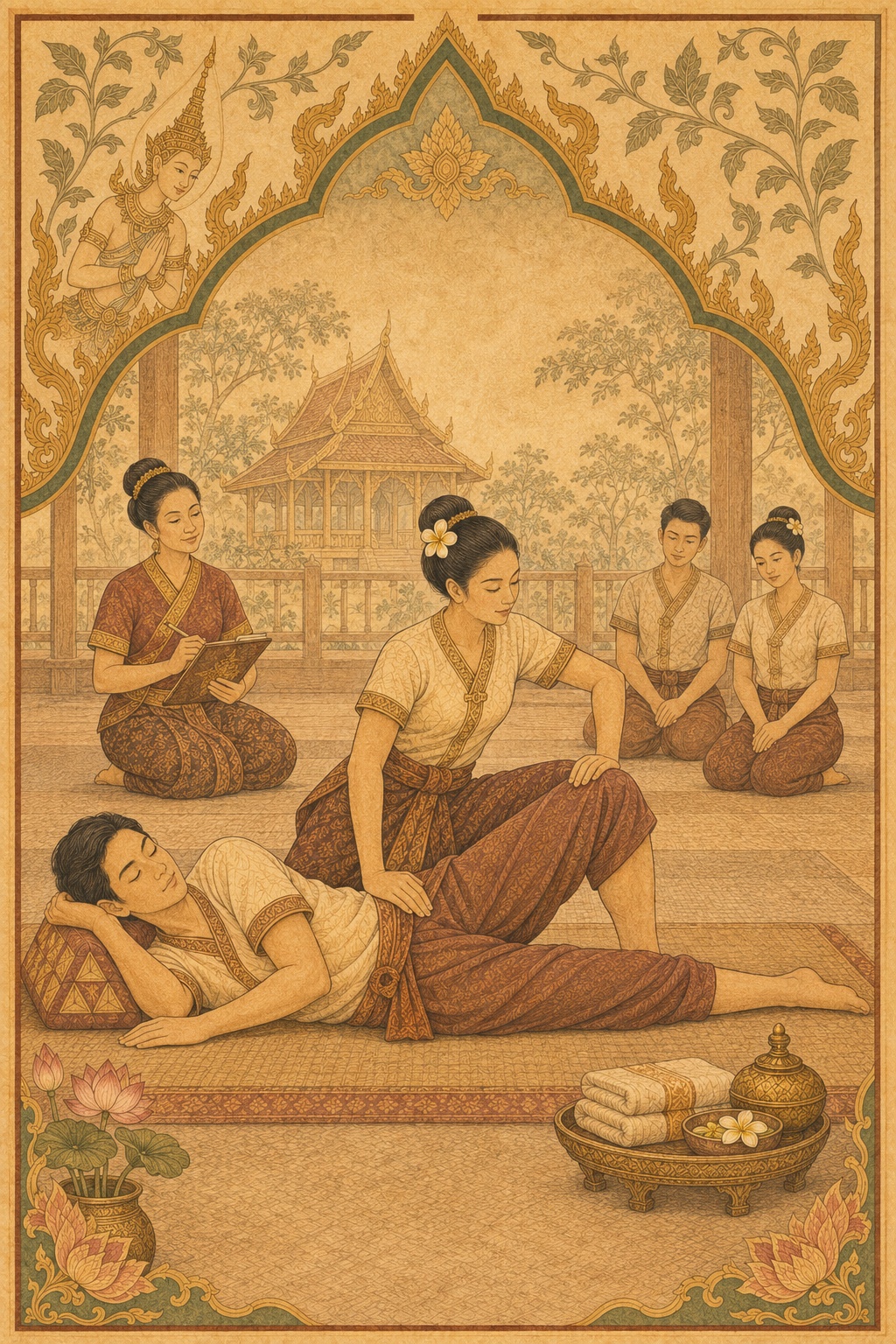
A student can reproduce the angle of a teacher’s stretch and still miss the part that matters. Watch what happens as the teacher comes back to rest. The person on the mat does not have to catch their own leg, hold their breath or guess which way they will move next. That return journey tells you something a photograph at the deepest point cannot. Someone has kept enough balance, contact and attention in reserve to change the plan.
Thai Warrior Massage brings a distinctive movement vocabulary to this problem. Nuad Thai School describes a private Bangkok course combining assisted stretching, dynamic pressure and Sen line work with grounded body mechanics. If you want to study the method, start with a question you could actually answer in a lesson. Can I help someone explore a small, agreed movement and bring it to a comfortable close the moment they ask? It is a more demanding test than it sounds.
What a flexibility study can tell a pair of hands
Consider a study of Thai massage in soccer players. Thirty-four division-two players in Thailand participated in a crossover experiment. In one period they received three half-hour sessions from trained practitioners over ten days. In another they rested for comparable periods. A three-week interval separated the periods. The researchers measured seven aspects of fitness including sit-and-reach distance, sprint speed and grip strength. Several scores improved from their starting values after massage. Even after rest, the players improved on the reach and sit-up tests.
The changes after massage did not differ significantly from the changes after rest on any of the seven measures. This is easy to miss if you read only the conclusion. Comparing a player with their earlier self asks whether their score changed over time. Comparing those changes across conditions asks whether receiving massage made a detectable difference. Familiarity with a test, day-to-day variation and other influences can affect the first comparison. The authors themselves describe substantial variability. A small study may miss a real effect, but it cannot tell a therapist to promise a faster sprint.
A systematic review of stretching intensity asked a narrower question. Of 16 studies examining range of motion, eight reported a larger gain with higher intensity and eight found no additional gain. The studies used different definitions of intensity, from ratings of discomfort to fractions of a measured torque. Many used machines to control the movement. Across the four studies examining strength, findings were mixed. Two studies contributed to both sets of results, so adding the participant totals would count some people twice.
These studies measured movement and strength under specified conditions. They did not identify a safe intensity for a student assisting another person on a mat. A larger angle after stretching cannot tell us whether a particular classroom movement was comfortable, appropriate or worth repeating. If someone can lift their arm a little higher after a rehearsal, it is fair to record what they did and how they described it. Declaring that a tissue has lengthened or an injury has resolved goes beyond the observation.
Sen lines have a different place in the discussion. The UNESCO archive account of Nuad Thai describes a tradition passed through communities, with Sen understood within traditional Thai healthcare. This helps explain why a Thai teacher may use a line of contact to organise a sequence. The heritage account describes inherited knowledge and does not establish a biomedical mechanism for a particular assisted stretch. A student can learn the traditional name and listen to its explanation while also identifying which joint moves, where weight is supported and when the person wants to stop.
What to watch from the side of the mat
Begin without a partner’s weight in your hands. Ask the instructor to demonstrate the opening and closing of one movement at the pace of a conversation. Watch the supports in contact with the floor. Notice when the instructor repositions their own knees or feet, when they ask a question and where the partner comes to rest. Then watch from the opposite side. A small shift of the teacher’s hips can be invisible from the front, even when it accounts for most of the movement you thought came from the arms.
In a supervised rehearsal, give the person receiving the movement a choice before touching them. Describe the starting position, the area you would support and the option of observing or moving independently. Agree on a spoken word or visible signal that means stop. Check that you can actually see or hear that signal from your working position. The Ontario massage regulator’s consent standard requires ongoing consent and monitoring in its jurisdiction. The regulator approved this version on 8 September 2026. In a Bangkok classroom it supplies a concrete discussion prompt. If the proposed contact or movement changes, explain the change and invite a fresh choice.
Leverage changes how much turning effect a force has around a joint. The same small push farther from the axis can have a larger effect. For the learner, the first application of that idea is restraint. When a position feels awkward, ask the instructor to check your base and the location of the support before attempting another repetition. Reaching farther along the limb simply to make it easier for yourself may increase the load the partner feels. If you cannot pause without gripping harder, return to the resting position with help and reorganise the setup.
For a lesson focused on that transition, discuss the private Thai Warrior course with Nuad Thai School. Tell the instructor where you habitually lose your balance, or which change of position feels rushed. Ask to practise just that portion in both directions. A teacher watching from the side can distinguish a partner lifting their own shoulder to help you from a change you actually guided. The person receiving the movement can add the missing information about timing, pressure or uncertainty. Neither view on its own gives you the whole picture.
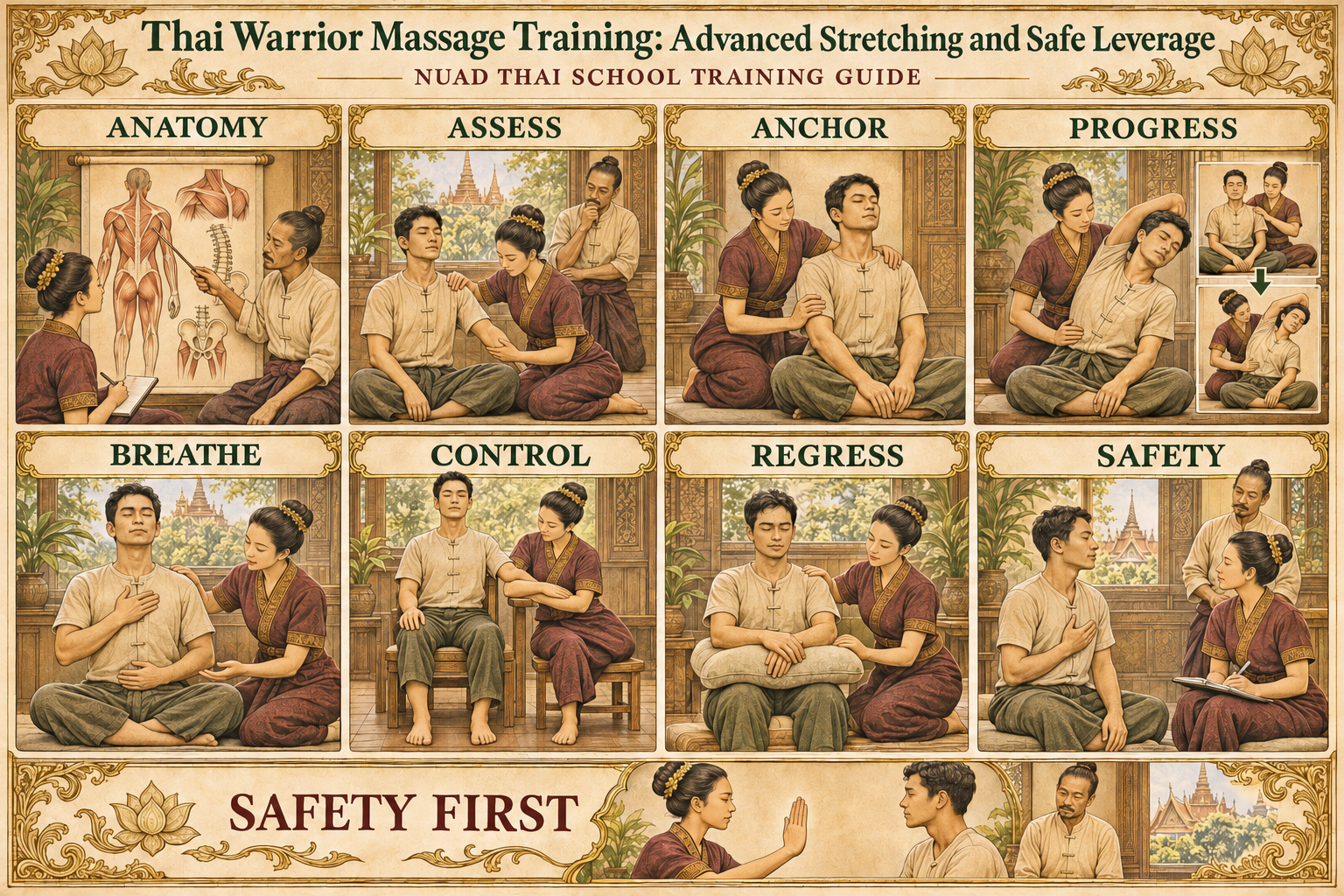
Decide what kind of practice the situation calls for
| What you observe | Choice for this lesson | What the instructor can assess |
|---|---|---|
| The volunteer wants to understand the movement first. | Demonstrate without contact and invite them to describe or show a comfortable direction themselves. | Can the student explain the activity clearly and accept a decision to observe? |
| The volunteer agrees, the starting position is comfortable and the student has stable support. | Rehearse a small supported movement under supervision, including the return to rest. | Can the student listen and pause without shifting the volunteer unexpectedly? |
| The volunteer reports feeling unsteady or unsure as the position changes. | Help them settle, release the demand and reconsider whether to continue. | Does the student investigate the uncertainty before proposing another movement? |
| The volunteer reports a fresh injury with increasing swelling. | Leave the affected area alone and direct the person towards appropriate healthcare. | Can the student end the exercise without trying to establish a diagnosis? |
The decision can change within a single repetition. An agreed starting position gives you a place to begin. It cannot tell you in advance how someone will feel when their support shifts. If you are observing a pair, note the first moment either person changes the plan. Ask what they noticed just before that moment. The answer is often more useful than a critique of the final posture because it identifies a cue the next pair can look for.
Three errors that can look like a successful stretch
The first is borrowing movement from somewhere else. A person seated on a mat may lean their trunk sideways as an arm rises. From the front, the hand reaches the height the student expected. From the side, the instructor sees that the trunk moved too. That observation alone does not diagnose a shoulder problem. It does give the pair a reason to ask what they intended to explore. Let the person return to a comfortable position and describe what moved. If isolating a joint would require holding them more firmly, the lesson can continue by observation.
The second is treating quietness as agreement. Someone concentrating on balance may wait for a pause before speaking. A polite general question at the end leaves few opportunities to change the experience. Ask a question that offers a real choice while the person is supported. Would they like to rest here, return, or end the exercise? Allow time for the answer. If a familiar shared language is missing, practise the signal at rest first, with teacher or interpreter support as needed.
The third is mistaking a large available range for an invitation. The NHS guidance on joint hypermobility describes people with very flexible joints who have no symptoms, as well as people who experience instability, repeated sprains or pain. The NHS advises people with symptomatic hypermobility against overextending a joint simply because the range is available. A student has no reason to reproduce a clinical flexibility test. Ask what feels supported and respect a preference to watch. A disclosure about recurrent dislocation is reason to involve the instructor and leave that joint out of assisted practice.
Two hypothetical classroom decisions
Hypothetical scenario one: the athlete who asks for a deeper stretch
A volunteer who plays football has an evening match and asks whether a deeper stretch will improve their sprint. The student has read the Thai soccer paper and remembers the improvements after massage. Before choosing a movement, the instructor asks which comparison would justify that promise. The student can now explain that performance was tested, that the players also rested under comparison conditions, and that the experiment did not establish a performance advantage over rest.
The student drops the sprint goal and offers observation or a modest supervised rehearsal only if the volunteer wants that different activity. If the volunteer is interested solely in improving tonight’s result, declining the exercise is a perfectly coherent outcome. In the debrief, the instructor can assess whether the student changed their explanation as well as their hand placement. A smaller version of a stretch still carries a misleading promise if the promise itself goes uncorrected.
Hypothetical scenario two: swelling after a missed step
A second volunteer mentions twisting an ankle that morning. It has become more swollen and walking is difficult. The pair had planned to practise moving between positions on the floor. Simply leaving the foot untouched would still require the volunteer to get down, change position and stand up again. The instructor considers the demands of the entire rehearsal, including the journey to and from the mat.
The student ends hands-on practice with this volunteer and asks the instructor to help them obtain appropriate medical advice about the injury. The NHS sprains and strains guidance advises avoiding massage early after an injury and seeking urgent help for significant or worsening swelling or inability to bear weight. It describes emergency signs after injury, including a changed shape, numbness or a cold or discoloured limb. Use local medical services where you are. The learner can continue by observing another demonstration without testing the ankle or suggesting when the volunteer should return.
What a teacher can reasonably mark
A teacher can see whether the learner describes the movement, keeps the partner supported, responds to a stop signal and manages a controlled return. The partner can report whether they felt able to interrupt. These are meaningful observations for a practice record. Write down the situation, the cue you missed and the change you made on the next attempt. A note such as “I had turned away and missed the first raised hand” gives the next lesson a specific starting point.
There is no universal safe angle or pressure prescription in the research reviewed here. The stretching review excluded injured participants and the soccer experiment involved trained players receiving a whole-body intervention from experienced practitioners. Neither design can establish the risk of a specific manoeuvre in someone recovering from surgery or with recurrent instability. Professional judgement includes recognising when the question belongs with the person’s healthcare professional. A supervised course can teach a learner to recognise such a boundary without qualifying them to manage the condition.
Choose the time and feedback you actually need
The school lists a senior instructor and a practice model for the private Warrior course. Its description includes both assisted stretching and traditional Sen line work. The course offers instruction in English or Thai, with private dates arranged on request. Its listed formats are three and a half hours, seven hours and fourteen hours. If your goal is one difficult transition, describe it before booking. If your goal is to link several movements into a sequence, ask how much time the chosen format allows for correction and another attempt.
The course is labelled professional, and the school says previous experience helps although most students need no formal prior experience. Someone new to mat work may prefer the Private Thai Massage Course, which starts with cultural foundations, body mechanics and full-body practice. A practising therapist seeking a broader curriculum can compare the Professional Thai Massage Course, a 150-hour pathway that includes theory and supervised sequence work. These answer different questions about learning time. Tell the school whether you are choosing your first foundation, refining one movement, or planning extended study.
FAQ
Do I need to be particularly flexible myself?
Think about the positions you can work in comfortably and how easily you change between them. A flexible student who balances by pulling on a partner still has something important to learn. Tell the school about difficulty kneeling, getting up from the floor or sustaining a position. Ask which teaching setup it can offer before deciding whether the course fits your needs.
What should I ask the practice model after a repetition?
Ask about one moment. For example, when I changed my support, did you feel you needed to hold your arm up yourself? That question lets the person describe an experience you might have missed. Then ask the instructor what they saw at that instant. Their answers can guide a specific correction without asking the model to grade the student or declare a movement medically safe.
Can I use this class to learn injury rehabilitation?
The course describes bodywork education. The studies discussed here cannot establish a rehabilitation plan or a return-to-sport decision for an individual. If your intended work involves treating injuries, discuss your existing clinical qualifications and scope with the relevant professional body. A useful learning goal for this class is being able to explain when you would stop a session and refer someone for assessment.
Can I learn with an interpreter?
The school accepts requests for interpretation for private in-person training in Bangkok and confirms availability directly. Include the language you need and your preferred dates when you enquire. If your main concern is giving or receiving a stop instruction, say so. A short exchange with the interpreter and instructor before the practical work can establish words and signals everyone understands.
What should I put in a booking request?
Give your experience level, preferred dates, number of students and language needs. Add one practical goal and any movement limitation relevant to participation. For instance, an experienced therapist might ask to practise returning a partner to rest without losing support. Use the Private Thai Warrior Massage Course page to discuss whether a shorter focused session or more time for supervised repetition fits that goal.
Sources and References
- Effects of Thai massage on physical fitness in soccer players — Journal of Physical Therapy Science
- The Effects of Static Stretching Intensity on Range of Motion and Strength: A Systematic Review — Journal of Functional Morphology and Kinesiology
- Joint hypermobility syndrome — NHS
- Sprains and strains — NHS
- Nuad Thai, traditional Thai massage — Thailand Ministry of Culture via UNESCO Multimedia Archives
- Standard of Practice: Consent — College of Massage Therapists of Ontario
- Private Thai Warrior Massage Course — Nuad Thai School