Advanced Prenatal Positioning and Massage Techniques is part of a five-article advanced prenatal massage course outline for Nuad Thai School. It turns a long curriculum into a focused blog lesson for massage students, spa therapists and wellness professionals.
A practical training guide to side-lying, semi-reclined and seated prenatal positioning, plus adapted Swedish, myofascial, trigger point, lymphatic and Thai-inspired techniques.
Important scope note: prenatal massage education supports comfort, relaxation, body awareness and professional care. It does not diagnose pregnancy complications, replace medical care or promise pregnancy, labor or postpartum outcomes.
Key Takeaways
- Advanced prenatal massage begins with screening, positioning, consent and referral logic before technique.
- Therapists must adapt pressure, duration, body area and client position to trimester, symptoms and medical context.
- This topic connects directly to the Private Prenatal Massage Course at Nuad Thai School.
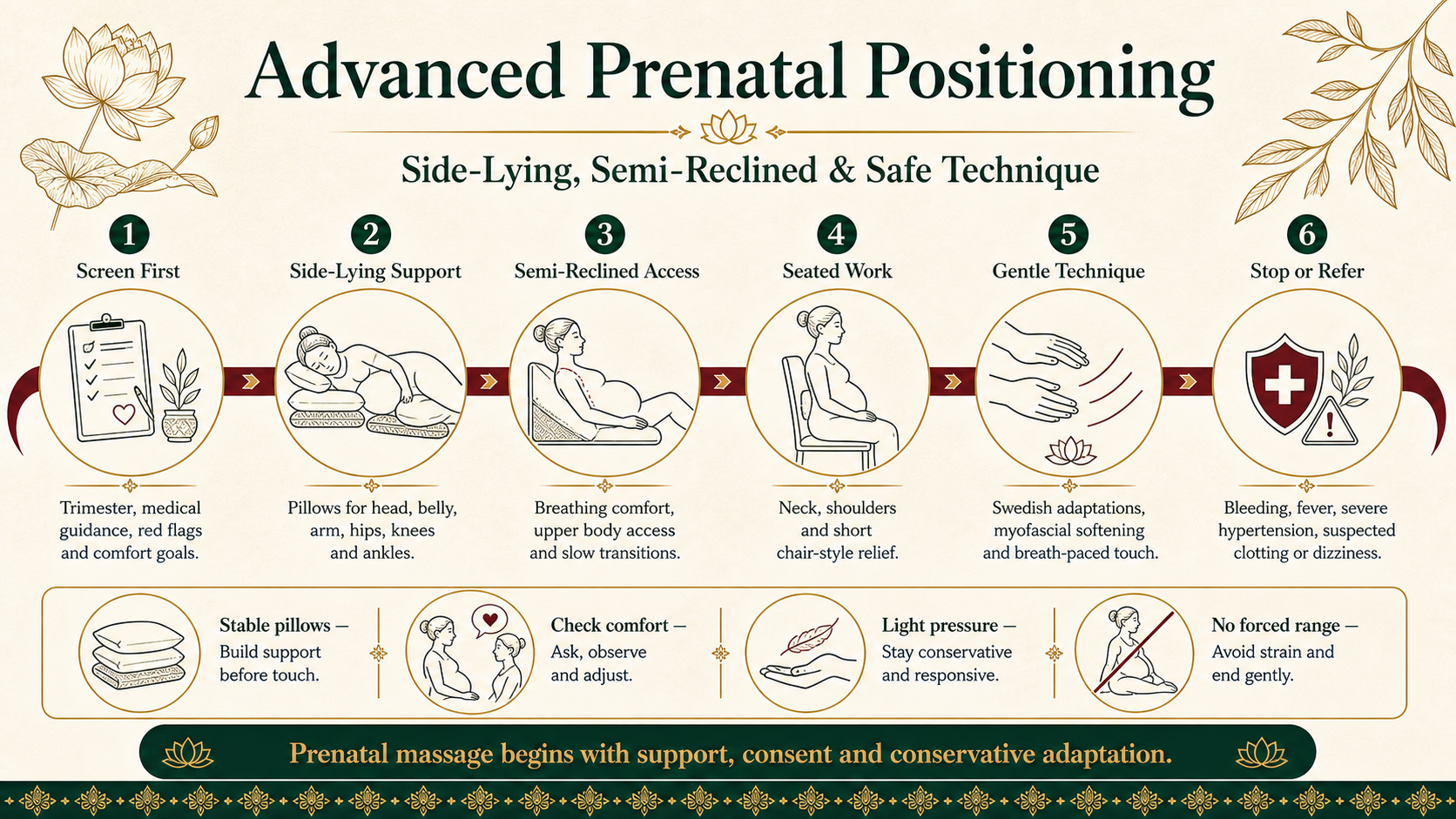
- Red flags such as bleeding, fever, severe hypertension, suspected clotting issues or preeclampsia symptoms require medical guidance rather than massage.
Side-Lying Position Mastery
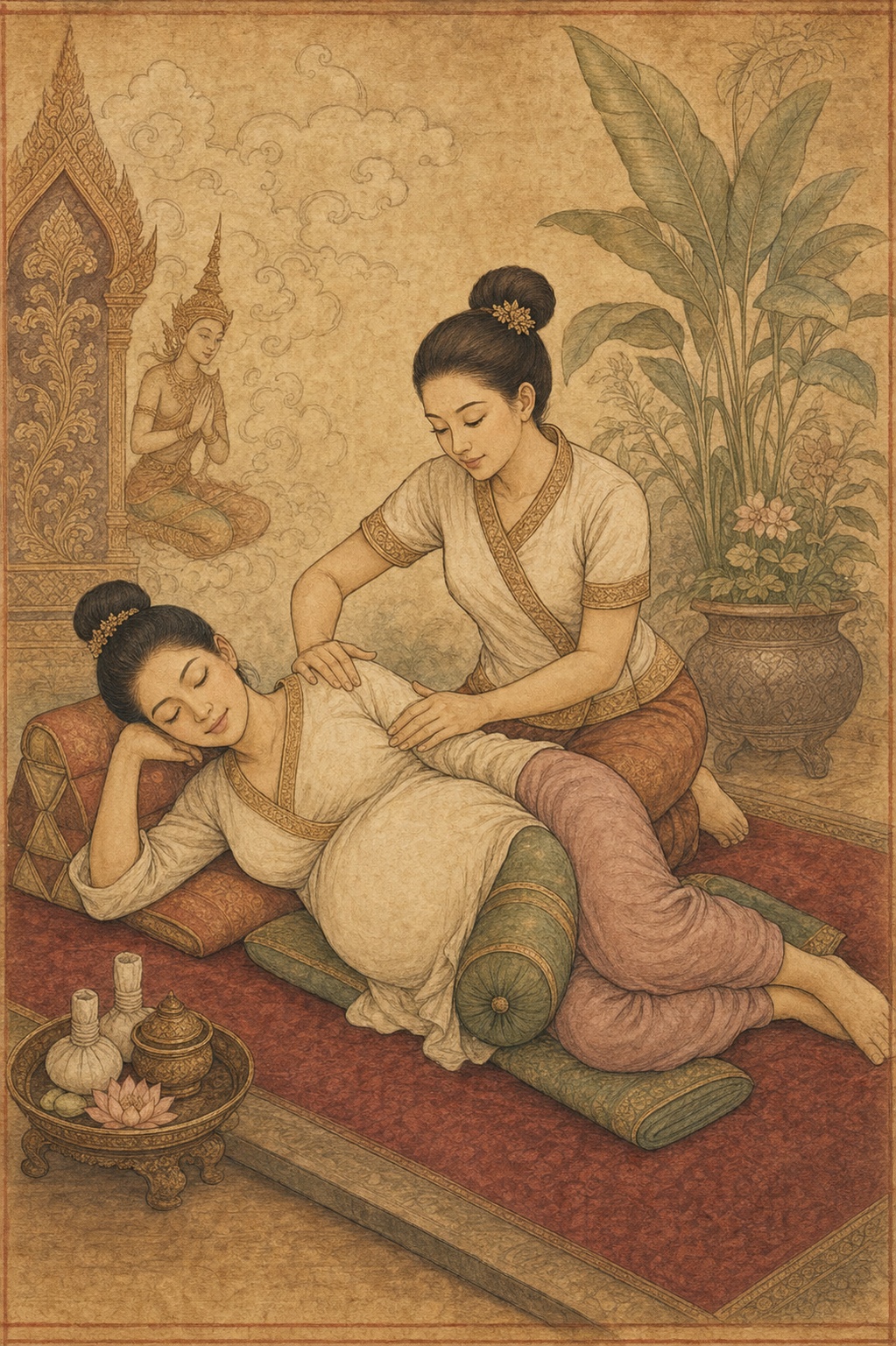
Side-lying is a core prenatal skill. Pillows support the head, belly, top arm, hips, knees and ankles so the client can relax without twisting. The therapist must also protect their own body mechanics while accessing the back, hips, legs and shoulders.
Semi-Reclined and Seated Techniques
Semi-reclined positioning can improve breathing and upper body access, while seated work is useful for neck, shoulders and short chair-style relief. Each transition should be slow, guided and checked for dizziness or discomfort.
Swedish Prenatal Massage Adaptations
Effleurage, gentle petrissage and safe friction can be used when pressure is responsive and the client is well supported. The rhythm should be slower than a standard deep spa session, with more attention to breath and comfort feedback.
Deep Tissue Adaptation and Myofascial Release
Advanced work is not forceful work. Deep tension can be approached through broad contact, gradual pressure, fascial unwinding and decompression rather than direct aggressive compression. The pelvis, lumbar area and gluteal region require precise positioning and conservative dosing.
Trigger Point and Lymphatic Drainage
Trigger point work can address gluteal, lumbar, neck and shoulder tension when performed in safe zones. Lymphatic drainage uses light pressure, slow rhythm and proximal-to-distal planning to support comfort with edema without claiming to treat a medical condition.
Thai-Inspired Stretching and Reflexology Concepts
Safe assisted stretches, hip opening and breath synchronization can bring a Thai-inspired identity to prenatal training. Reflexology concepts should remain conservative, avoiding areas the school defines as unsuitable during pregnancy and prioritizing relaxation protocols.
Training Infographic
Professional Decision Matrix
| Layer | What to cover | Training cue |
|---|---|---|
| Anatomy | uterus and pelvis, placenta, amniotic sac, hormonal change, lymphatic flow, posture, lumbar load and breathing mechanics | Name the tissues and vulnerable structures before choosing pressure. |
| Technique | supported side-lying massage, semi-reclined access, seated work, gentle Swedish adaptations, myofascial softening, lymphatic drainage and breath-paced touch | Teach movement slowly, then add rhythm and feedback. |
| Safety | screen high-risk pregnancy, preeclampsia, vaginal bleeding, suspected clotting issues, placental complications, fever, severe hypertension and medical red flags | Modify, stop or refer when the client's condition requires it. |
| Course path | Private Prenatal Massage Course | Connect the topic to supervised practice in the related course. |
Sources and Safety Frame
The generator checked pregnancy-specific ACOG resources, NCCIH massage safety information, lymphatic physiology references and a recent PubMed watch. The article uses those signals to keep the tone educational, conservative and appropriate for a school blog.
FAQ
What is the safest default position for many prenatal sessions?
Supported side-lying is often the most adaptable because it protects the belly, hips, breathing and lower back.
Can Thai-inspired stretching be used in prenatal massage?
Yes, but only with gentle range, stable support, breath synchronization and no forced end-range movement.
Study This Topic in Bangkok
Students who want supervised practice can continue with the Private Prenatal Massage Course. Reading builds the theory; hands-on correction builds the professional touch, body mechanics and confidence required for maternal care.