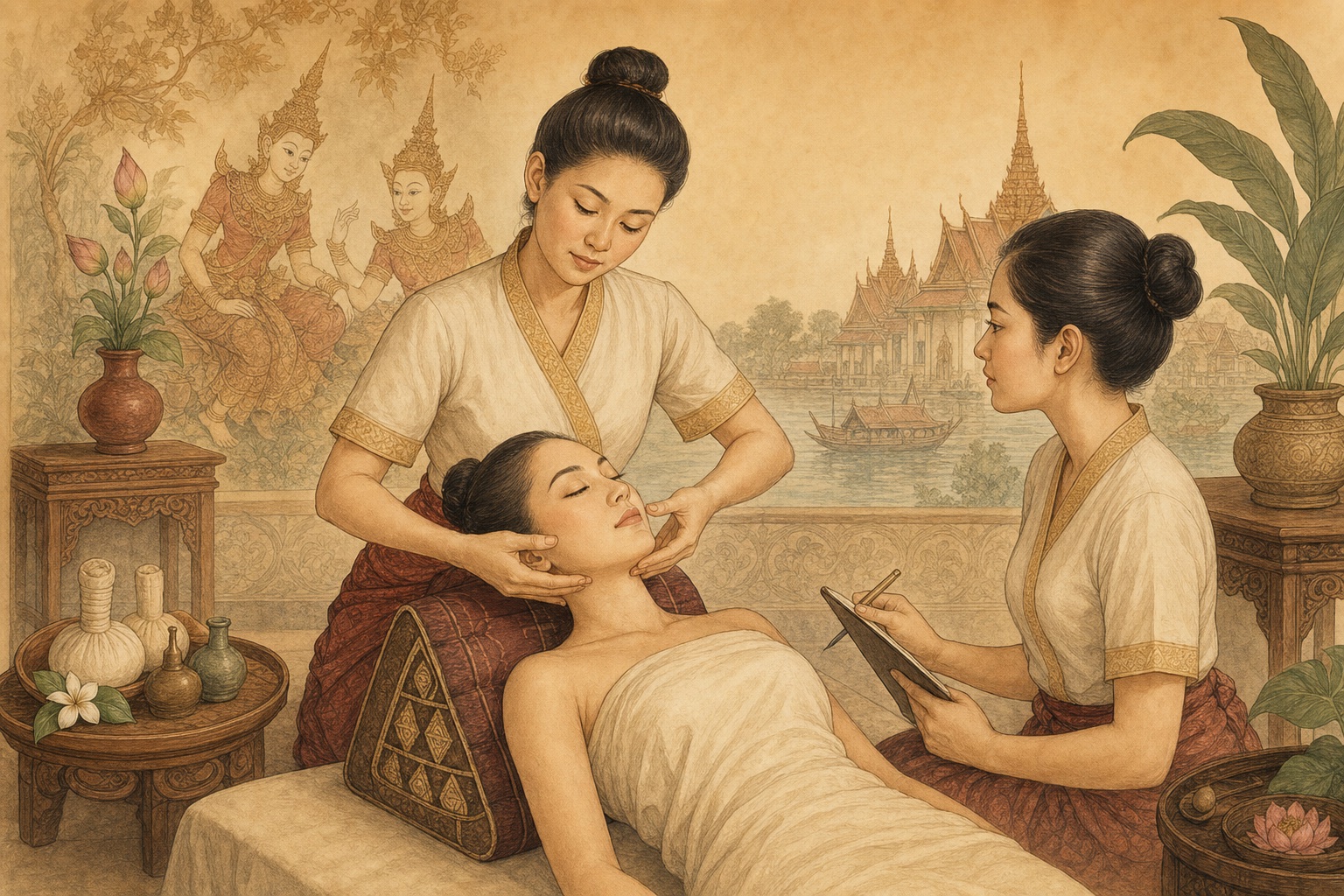
Facial sculpting training is the professional study of how to use precise, gentle, well-sequenced touch on the face, jaw, neck and upper chest to create a lifted, relaxed and visibly refined spa result. It is not a medical face-lift, not a promise to change anatomy, and not an aggressive beauty shortcut. In a serious school setting, facial sculpting means learning facial anatomy, lymph flow, skin safety, product hygiene, client communication and a repeatable hands-on protocol that can be adapted to many face shapes and skin conditions.
This complete guide is written for students, spa therapists, massage professionals and beauty practitioners who want to understand what a high-quality facial sculpting course should include. The focus is practical: what to learn first, how the sequence is structured, which tissues are involved, how pressure should feel, when not to work, and how Nuad Thai School connects this topic to professional facial treatment training in Bangkok.
Important scope note: facial sculpting massage can support relaxation, a brighter-looking complexion, temporary reduction of puffiness and improved body awareness for some clients. It should not be presented as a cure for skin disease, a replacement for dermatology, or a guaranteed anti-aging procedure. Responsible training uses anatomy and wellness language honestly.
Key Takeaways
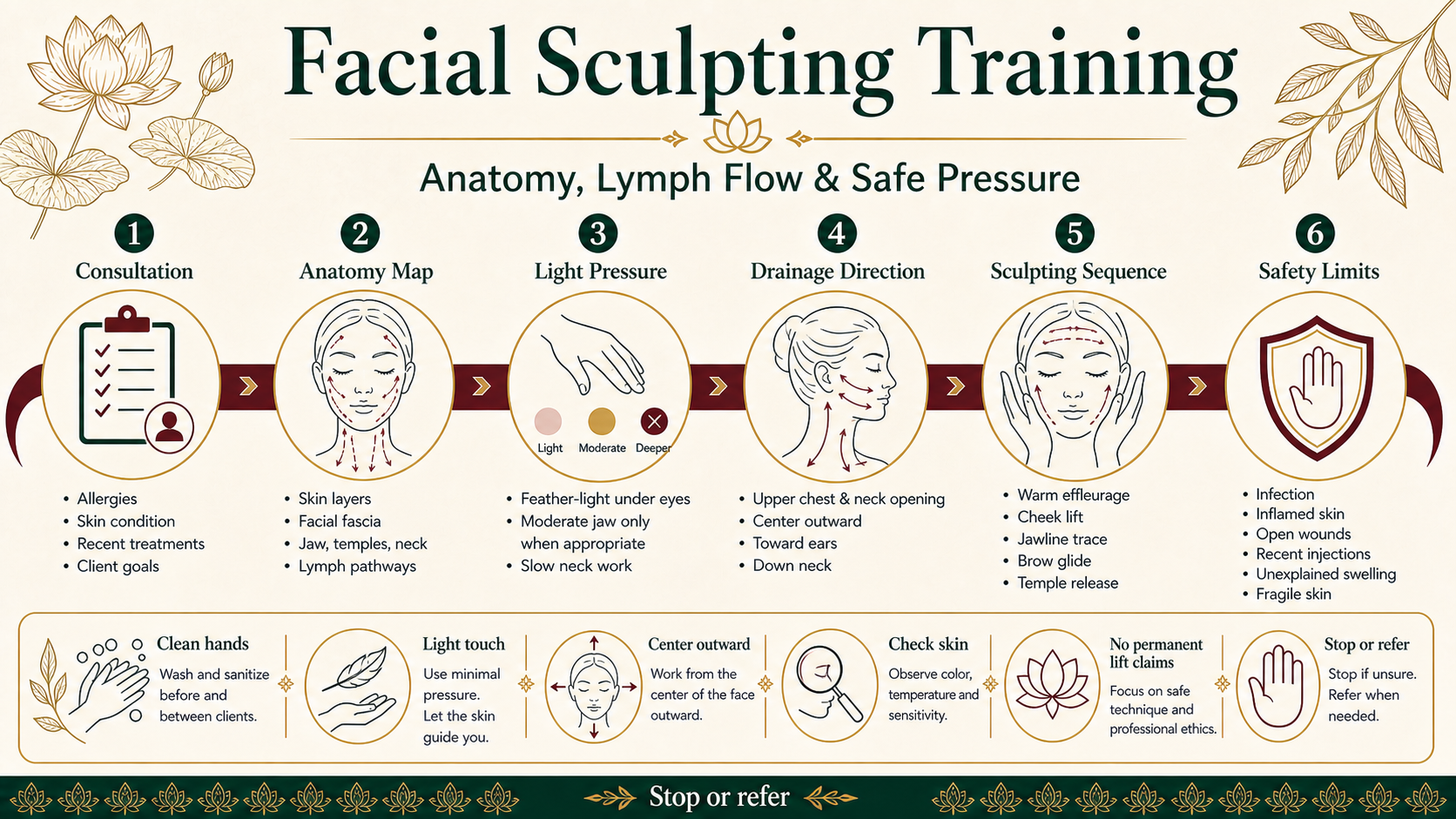
- Facial sculpting training begins with hygiene, consultation and skin observation before any lifting technique.
- The core anatomy includes skin layers, superficial fascia, facial expression muscles, the jaw, the temples, the neck and lymphatic pathways.
- The best pressure is usually light to moderate, slow, specific and responsive to tissue sensitivity.
- Contraindications include active infection, inflamed skin, open wounds, recent injections, unexplained swelling, fever and fragile or painful skin.
- Students who want hands-on correction can continue through the Private Facial Treatment Course at Nuad Thai School.
What Is Facial Sculpting Training?
Facial sculpting training teaches a therapist to organize facial massage around structure. Instead of moving randomly over the skin, the student learns how to prepare tissue, encourage gentle drainage, soften jaw tension, lift along the cheeks, relax the temples and complete the treatment through the neck. The word sculpting can sound dramatic, but in professional education it should mean precision, rhythm and intelligent sequencing.
A beginner often thinks the face needs many small complicated moves. A skilled teacher usually begins with fewer movements performed better: clean contact, stable wrist position, soft fingertips, slow breathing, smooth product control and a clear direction for each stroke. Once those basics are reliable, the sequence can include cheek lifting, jaw contour work, brow release, temple circles and lymphatic-style finishing.
The training also changes how students look at a client's face. Puffiness, jaw clenching, tired eyes, forehead tension and neck stiffness are not treated as isolated beauty problems. They are read as patterns that may involve sleep, stress, posture, hydration, expression habits and product sensitivity. The therapist stays inside their scope while still offering thoughtful, professional care.
Why Facial Sculpting Is Popular in Spa Education
Facial sculpting is popular because clients increasingly want visible freshness without a harsh or clinical feeling. Many people spend long hours looking at screens, clenching their jaw, holding the neck forward and carrying stress in the face. A well-designed facial sculpting session gives them a sense of relief, definition and care while staying within the calm language of spa therapy.
For a spa or wellness clinic, facial sculpting also creates a premium service path. It can sit between a classic facial and a deeper massage treatment: more technical than simple product application, more holistic than a beauty routine, and more personal than a machine-led service. Therapists who understand face and neck technique can upgrade menus, improve client retention and communicate more confidently.
For students, the attraction is skill. Facial work is unforgiving in a good way. Heavy hands, poor hygiene, unclear pressure and nervous movements are immediately obvious. Training the face forces a therapist to become quieter, more observant and more precise. Those qualities improve every other massage discipline too.
Facial Anatomy Students Must Understand
A facial sculpting course should introduce anatomy in practical language. Students do not need to become doctors, but they do need to know what lies under their hands. The face includes thin skin, oil glands, sensory nerves, small muscles of expression, superficial fascia, lymphatic capillaries, blood vessels and bony landmarks such as the cheekbones, jaw and orbit around the eyes.
The cheeks and jaw are important because many clients hold tension through the masseter and surrounding soft tissue. Gentle jaw work can feel deeply relieving, but direct pressure must be controlled. The temples require calm circular contact rather than sharp pressure. The under-eye area is delicate and should be treated with feather-light drainage-style strokes, never forceful rubbing.
The neck is part of the facial sculpting story. A face treatment that ignores the neck often feels incomplete because lymphatic pathways and postural tension continue downward. Students learn to work gently around the sides of the neck, upper chest and shoulder line while avoiding strong pressure over vulnerable structures. The goal is connection, not intensity.
Lymph Flow, Puffiness and Honest Claims
Many facial sculpting courses mention lymphatic drainage. This can be useful when taught carefully. The lymphatic system helps move fluid through a network of vessels and nodes, and light rhythmic touch may support a feeling of decongestion or reduced puffiness for some clients. However, this should be described as wellness support, not as treatment for disease.
Training should make the direction simple: open the neck and upper chest gently, work from the center of the face outward, guide fluid toward the preauricular area near the ears, then finish toward the cervical pathways of the neck. The pressure is light because lymphatic capillaries are superficial. If a student presses hard, they are no longer doing drainage-style work; they are compressing tissue.
Honest language builds trust. A therapist can say that a session may help the face look fresher temporarily because touch, relaxation and fluid movement can change appearance. A therapist should not say that massage removes toxins, cures sinus disease, permanently lifts sagging skin or replaces medical care. This distinction is part of professional maturity.
Client Consultation and Skin Safety
Before technique, students must learn consultation. The therapist asks about allergies, product sensitivity, active skin conditions, recent facial treatments, injections, dental work, fever, medications that affect skin fragility, and the client's goal for the session. This conversation should feel calm and discreet, not like an interrogation.
Contraindications are central. Facial sculpting should be postponed or modified when there is active infection, open wounds, inflamed acne, unexplained swelling, sunburn, fever, contagious skin conditions, recent surgery, fresh bruising or recent injectables where pressure is not appropriate. If the client has a medical skin condition or unusual symptoms, the therapist should refer the question to a qualified clinician.
Skin safety also includes product choices. Simple, low-irritation products are often better for training than complex formulas. Students learn to avoid dragging the skin, overusing oil, working too close to the eyes, mixing active products carelessly or applying strong fragrance without consent. A clean, consistent product protocol protects both client and therapist.
The Professional Facial Sculpting Protocol
A complete facial sculpting protocol should feel like a journey. It begins with preparation, moves into observation, opens drainage pathways, warms the tissue, works the jaw and cheeks, releases the brow and temples, finishes through the neck, then closes with aftercare. The sequence matters because the face responds better to gradual invitation than sudden force.
| Training layer | What the student learns | Professional purpose |
|---|---|---|
| Consultation | Skin condition, treatment history, comfort goals, allergies and recent aesthetic work. | Decide whether to continue, modify, postpone or refer. |
| Preparation | Hand hygiene, clean linens, simple product setup, hair protection and quiet room rhythm. | Create a treatment surface that feels premium and controlled. |
| Assessment | Jaw tension, facial expression habits, neck holding, puffiness, redness and sensitivity. | Map the session before pressure begins. |
| Sculpting sequence | Lymphatic opening, warm effleurage, jaw and cheek lifting, temple release, neck finish. | Build visible structure through slow repetition, not force. |
| Aftercare | Redness check, hydration guidance, product notes and clear home-care limits. | Help the client leave informed without exaggerated claims. |
Step one is room and tool preparation. Linens, towels, bowls, products and hand hygiene should be ready before the client lies down. Step two is positioning. The head, neck and shoulders must be supported so the client does not unconsciously hold tension. Step three is cleansing and first contact, where the therapist observes temperature, redness, dryness, puffiness and sensitivity.
Step four is lymphatic opening. The therapist uses very light contact around the upper chest, collarbone area and sides of the neck. Step five is facial warm-up with gentle effleurage from the center outward. Step six is sculpting work: slow cheek lifts, jawline tracing, masseter softening, nasal fold smoothing, brow glide and temple release. Step seven closes with calming strokes, product removal if needed and a final still contact.
Hands-On Technique: Pressure, Direction and Rhythm
Pressure in facial sculpting should be intelligent rather than impressive. On the cheeks and jaw, moderate pressure may be appropriate when tissue is healthy and the client enjoys the sensation. Around the eyes, pressure should be extremely light. On the neck, work should be slow and cautious. Students should be able to explain why each area receives a different level of contact.
Direction gives the work its sculpting quality. Strokes often move from the center of the face outward and upward, then finish toward the side of the face and down through the neck. The therapist keeps contact broad enough to feel supportive and specific enough to define the line of the cheek or jaw. Repetition creates the visible effect more than force does.
Rhythm is the part clients remember. A rushed facial feels technical but not luxurious. A slow rhythm lets the nervous system settle, gives the skin time to respond and helps the therapist notice subtle changes. In class, students should practice counting, breathing and moving their body weight from the feet rather than working only from the fingers.
Tools, Gua Sha and Manual Skill
Some facial sculpting methods include tools such as gua sha, rollers or cool stones. These can be useful when the therapist understands hygiene, angle, pressure and contraindications. They should not replace manual skill. A tool in an untrained hand can create redness, irritation or bruising, while a trained hand can adapt instantly to the client's feedback.
Nuad Thai School's training philosophy favors hands-on clarity first. Students should understand the tissue response with their fingers and palms before adding tools. If tools are introduced, they should be cleaned correctly, used with suitable glide, kept away from inflamed areas and presented as spa support rather than a medical intervention.
Complete Infographic
Common Mistakes Beginners Make
The first common mistake is using too much pressure. Students may think stronger work creates a stronger result, but the face often rewards patience. The second mistake is ignoring the neck, which can leave the treatment feeling disconnected. The third is poor product control: too much oil makes the hands slide without purpose, while too little product creates drag.
Another mistake is copying social media movements without understanding why they are done. A beautiful-looking stroke can be unsafe if it is too hard, too fast or poorly placed. Professional training slows everything down. The student learns what the movement is for, where it begins, where it ends, how it feels to receive, and what to change for different clients.
How to Choose a Facial Sculpting Course
A good course should include live demonstration, supervised practice, anatomy, consultation, contraindications, hygiene, product safety, sequence design and instructor correction. It should not be only a list of movements. Students should leave with a protocol they can perform, but also with decision-making skills that help them adapt safely.
Look for a course that teaches both beauty and responsibility. The beauty side includes flow, face contour awareness, client comfort, premium service details and aftercare. The responsibility side includes scope of practice, referral logic, modest claims and respect for the skin. A therapist who combines both sides can offer a more trustworthy service.
At Nuad Thai School, students can connect this article to the <a href="/courses/facial-treatment/">Private Facial Treatment Course</a>. The advantage of studying in Bangkok is not only technique; it is learning within a spa culture where touch, rhythm, hospitality and practical correction matter.
Professional Aftercare and Client Education
Aftercare should be simple. The therapist can suggest drinking water, avoiding strong exfoliation immediately after the session, observing how the skin responds, and communicating any unusual irritation. Clients should understand that temporary redness can happen, but pain, strong swelling, heat or symptoms that worry them deserve medical advice.
Client education should never create dependency. A professional does not tell clients they need constant sculpting to look acceptable. Instead, the therapist frames the treatment as care: a way to relax, refresh, notice tension habits and maintain a thoughtful wellness routine. This tone fits a premium spa and protects the dignity of the client.
Sources and Research Watch
This article follows the blog's researched-article protocol: standing sources are checked first, recent PubMed signals are scanned, and the final writing keeps medical claims conservative. The research layer informs anatomy, safety, lymphatic language and referral boundaries; it does not turn a spa service into a medical treatment.
FAQ
Is facial sculpting training suitable for beginners?
Yes, if the course teaches slowly and includes supervision. Beginners should start with hygiene, consultation, anatomy, pressure control and a simple sequence before learning advanced sculpting movements.
Can facial sculpting massage permanently change the face?
No responsible school should promise permanent structural change from massage. The realistic goals are relaxation, temporary freshness, reduced-looking puffiness for some clients, softer jaw tension and a more refined spa experience.
How long should a facial sculpting session last?
Training protocols often range from short focused work to a full facial treatment. For learning, the important point is not duration alone but sequence quality, client comfort, skin response and safe adaptation.
What should students avoid during facial sculpting practice?
Avoid inflamed or broken skin, active infection, strong under-eye pressure, painful jaw compression, recent injections, aggressive tool scraping, untested products and exaggerated claims.
Study Facial Treatment in Bangkok
Reading a complete guide helps you understand the map. Hands-on training helps you build touch. If you want instructor correction, body mechanics, product control and a practical spa facial protocol, continue with the <a href="/courses/facial-treatment/">Private Facial Treatment Course</a> at Nuad Thai School in Bangkok.