コース詳細
コース概要
トレーニングに含まれる
参加できる人
こんな方におすすめ
研修の流れ
コースの流れ
通訳オプションあり · 受講者1名・半日につき3,000 THBの追加料金 バンコクでの対面プライベート講座限定です。
プライベート講座では、フランス語、中国語(普通話)、日本語、ロシア語、スペイン語、ドイツ語、イタリア語の通訳をお申し込みいただけます。
通訳の手配可否と最終日程は学校が確認します。
コースに関するよくある質問
よくある質問
Answers for Private Deep Tissue Massage Course, including level, format, certificate, preparation, booking and training flow.
Who is the Private Deep Tissue Massage Course designed for?
The Private Deep Tissue Massage Course is designed for Beginners, Spa and wellness professionals, Experienced therapists and Spa owners who want structured, personal training rather than a crowded classroom experience. It works well if you are starting from zero, refreshing an existing skill, preparing to work in a spa, or adding a specialized treatment to your current menu. The focused format lets the instructor understand your background, physical confidence, preferred pace and professional goals before moving deeply into technique. Because the course is practical, you should be comfortable observing, practicing and receiving correction throughout the class. Students often choose this course when they want a clear method, direct feedback and a Bangkok-based learning environment connected to real spa practice.
What will I be able to do after completing the Private Deep Tissue Massage Course?
After completing the Private Deep Tissue Massage Course, you should understand the purpose, structure and safe delivery of the treatment at a foundation or professional level, depending on the format you choose. The course is built around course goals, client comfort and deep tissue safety overview, instructor demonstration of pressure, rhythm and body mechanics, guided practice on back, shoulders, hips and legs, supervised corrections for angle, posture and pressure quality and treatment flow, aftercare and certificate guidance, so the learning is not limited to watching demonstrations. You practice the sequence, learn how each step connects to the next, and receive corrections on pressure, rhythm, body position, hygiene, communication and client comfort. By the end, you should be able to organize a complete treatment flow, explain the main precautions, and continue practicing with a much clearer framework. Like any hands-on therapy, confidence grows with repetition, but the course gives you a serious base for continued development.
How practical is the training during the Private Deep Tissue Massage Course?
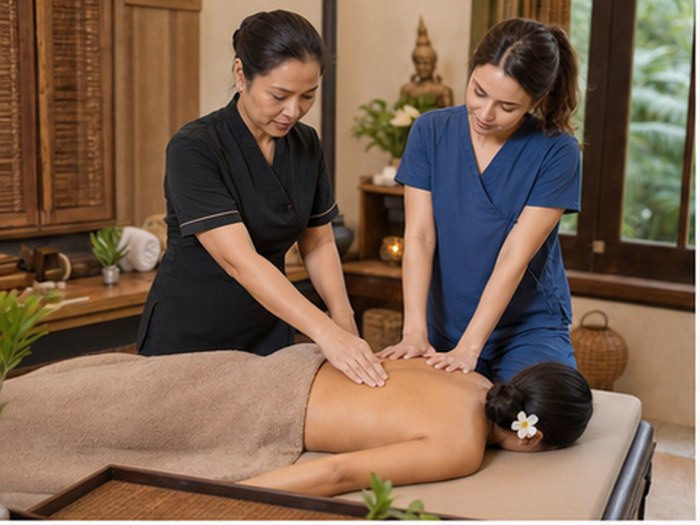
The Private Deep Tissue Massage Course is strongly practical. The instructor does not simply describe techniques; they demonstrate the movement, explain why it is used, and then supervise your own practice step by step. You learn by seeing, doing, adjusting and repeating, which is especially important for bodywork because pressure, angle, rhythm and therapist posture cannot be mastered from theory alone. The training normally includes English or Thai instruction, Senior instructor, Assistant or practice model, Deep tissue foundations, Forearm and elbow technique, Pressure control and Client communication, with corrections adapted to your body mechanics and learning speed. The goal is to help you feel the difference between a technique that looks correct and a technique that is comfortable, safe and professional for the client.
入会する前にマッサージやスパの経験は必要ですか?
Previous experience is helpful but not required for most students taking the Private Deep Tissue Massage Course. The course page identifies the level as Beginner to Professional, which means the instructor can adapt explanations and practice details to your background. Beginners usually spend more time on posture, hand placement, treatment order, client communication and basic safety. Experienced therapists can move faster through the fundamentals and use the focused format to refine precision, pressure quality, transitions and professional application. If you already work in wellness, the course can help you compare your existing habits with Thai spa standards. If you are new, it gives you a structured introduction without assuming you already know the vocabulary of massage training.
このコースでは、安全性、禁忌、患者の快適さについてどのようにカバーされていますか?
Safety is treated as part of the technique, not as a separate theory note at the end of the Private Deep Tissue Massage Course. The instructor explains how to prepare the client, observe comfort, communicate about pressure and recognize situations where a technique should be softened, avoided or adapted. Depending on the course, this may include hygiene, heat control, product use, pregnancy considerations, deep pressure limits, posture issues, sensitive areas or equipment handling. You also learn to protect yourself as the practitioner by using better body mechanics instead of forcing movements with your hands or shoulders. This practical safety layer matters because a good treatment must feel effective while remaining respectful, controlled and appropriate for the person receiving it.
How long is the Private Deep Tissue Massage Course and what training options are available?
利用可能な形式は、半日 (3 時間 30 分)、全日 (7 時間)、および 2 日 (14 時間) です。最初にリストされているオプションは、半日、3 時間 30 分、1 人あたり 13,500 バーツです。これらの形式は、生徒によって必要な深さが異なるため便利です。短いオプションでは重要なメソッドを導入できますが、長いトレーニングでは繰り返し、修正、質問、治療の流れにより多くの時間が与えられます。あなたの背景、スケジュール、目標を説明すると、学校は最も適切な選択肢を確認します。完全な初心者の場合、動きが自然になる前に体が反復する必要があるため、十分な練習時間を選択することが重要です。セラピストやスパ チームの場合、特定のスキルを向上させるには、焦点を絞った短い形式で十分かもしれませんが、より多くの監督と自信が必要な場合には、追加の時間は依然として価値があります。
Is the Private Deep Tissue Massage Course taught in English?
Yes. The listed teaching language for the Private Deep Tissue Massage Course is English or Thai, so international students can follow the class without needing to speak Thai. The focused teaching setting also makes language support easier because you can slow down, ask for a demonstration again, clarify a safety point or request different wording when a technique feels complex. Massage training is visual and physical as well as verbal, so the instructor combines explanation with demonstration, guided practice and direct correction. This helps students who are learning in a second language because they can connect the words to the movement immediately. If you need a specific language arrangement, it is best to mention it when booking so the school can confirm availability.
Will I receive a certificate after the Private Deep Tissue Massage Course?
The Private Deep Tissue Massage Course includes School Certificate, provided you complete the selected training format and meet the course requirements confirmed by the school. A certificate is useful as evidence of attendance and study, but the real value is the quality of the training behind it: supervised practice, correction, safety understanding and a treatment structure you can continue developing after the class. For professional or UTTS-linked pathways, the school can explain any assessment, hour requirement or documentation needed before enrollment. If you plan to use the certificate for employment, insurance, a spa menu or a business application, ask in advance what wording appears on the certificate and whether the chosen course format matches your objective.
What should I prepare before attending the Private Deep Tissue Massage Course?
バンコクで参加する前に、コースのスタイルに応じて、動きやすく、伸びたり、ひざまずいたり立ったりしやすい快適な服装を着用してください。また、練習したり、質問したり、詳細な修正を受けたりする準備ができている必要があります。トリートメントにオイル、石、ハーブ、カップ、スキンケア製品、竹製の道具、またはその他の素材が使用される場合、学校は何が提供され、セッションに何が必要かを明確にします。一日中トレーニングを終えた後は、小さな姿勢の手がかりや順序の詳細は忘れがちなので、開いたノートや電話のメモも持参してください。インストラクターがあなたの状況を早期に理解すると、集中したトレーニングを調整できることが多いため、コースの開始前に怪我、妊娠、身体的制限、または職業上の目標についてチームに伝えると役立ちます。
How do I book the Private Deep Tissue Massage Course and choose my schedule?
To book the Private Deep Tissue Massage Course, use the course booking link and share the course name, preferred dates, number of students, language needs and your current experience level. Availability is listed as On request, so the school normally confirms the exact schedule directly rather than forcing every student into one fixed public date. The class is taught in Bangkok in a private training environment, with the instructor adapting the rhythm of the day to your goals and practice level. After you send your request, the team can guide you toward the best duration, explain payment or deposit steps, confirm the instructor and answer practical questions about location, preparation or certificate expectations. If you are comparing several courses, describe your main goal first; that makes it easier for the school to recommend the most useful training path.
プライベート講座に通訳を付けられますか?
はい。バンコクでの対面プライベート講座に、フランス語、中国語(普通話)、日本語、ロシア語、スペイン語、ドイツ語、イタリア語の通訳を申し込めます。追加料金は受講者1名につき半日3,000 THB、1日6,000 THB、2日12,000 THBです。手配可否は学校が確認します。