Quick answer
Thai Massage Moves The Body. Shiatsu Listens Through Pressure.
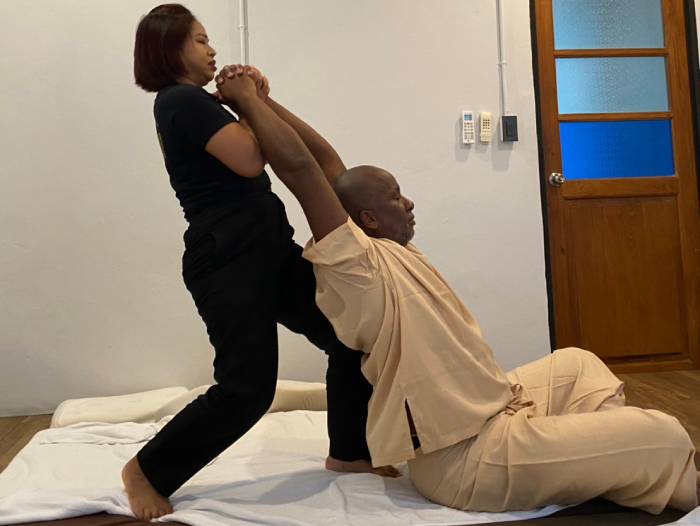
Traditional Thai massage, often called Nuad Thai, is an active, floor-based bodywork system. The receiver normally stays clothed and lies on a mat while the practitioner applies palm pressure, thumb pressure, rocking, traction, joint mobilization and assisted stretches. A full session can feel like a carefully guided movement practice where the client remains passive but the body is repositioned many times.
Shiatsu is a Japanese bodywork method that also works through clothing and often takes place on a futon or firm mat. Its signature is sustained pressure applied with fingers, thumbs, palms, elbows or knees along meridians and specific points. The rhythm is usually quieter than Thai massage. Rather than moving the client through large stretches, Shiatsu often uses stillness, leaning pressure and subtle assessment to encourage balance.
The simplest comparison is this: Thai massage is more dynamic and stretch-led; Shiatsu is more point-focused and meditative. Both can be deeply relaxing, both require sensitive body mechanics, and both can be adapted for different bodies. But a therapist trained in Thai massage learns sequence, transitions, leverage and assisted mobility in a way that is distinct from Shiatsu's Japanese pressure-based framework.
Origins
Two Traditions, Two Cultural Roots.
Thai massage and Shiatsu belong to the broad family of Asian bodywork, but each grew from a different medical and cultural environment.
Thai massage: Nuad Thai and Thai traditional medicine
Thai massage developed inside Thai healing culture, where massage, herbs, steam, stretching and Buddhist care values were used together. It is associated with Sen lines, practical temple medicine and a hands-on teaching tradition that values rhythm, humility and whole-body support.
Shiatsu: Japanese pressure therapy
Shiatsu developed in Japan and was shaped by Japanese manual therapy, anma massage, meridian theory and modern therapeutic education. Its name is commonly understood as finger pressure, but a skilled session uses the practitioner's whole body, not just the thumbs.
The shared idea is that touch can support balance beyond simple muscle relaxation. The difference is how that idea becomes technique. Thai massage often uses the therapist's body as a moving lever to stretch, compress and reposition the receiver. Shiatsu often uses still leaning pressure to meet resistance, notice change and settle the body through measured contact.
Session feel
What A Client Actually Feels On The Mat.
A Thai massage session usually feels spacious and physical. You may begin on your back, then move to side-lying, prone and seated positions. The therapist may press along the legs, open the hips, mobilize ankles, stretch hamstrings, rotate shoulders, compress the back and finish with neck, scalp or seated work. The body is treated as one connected structure.
A Shiatsu session often feels quieter. The practitioner may hold pressure at a point, lean in with a steady exhale, release, then move along a meridian line. The receiver may feel a deep, grounded contact rather than a big stretch. Some sessions include gentle rotations or stretches, but the central experience is usually the quality of pressure and the practitioner's ability to wait, listen and respond.
For spa guests, the choice often depends on the desired mood. If you want to feel opened, stretched, mobilized and energized, Thai massage is usually the more direct match. If you want a still, contemplative session with less repositioning, Shiatsu may feel more natural. For students, the choice depends on the professional skill set they want to build first.
Technique map
Pressure, Stretching, Rhythm And Therapist Body Mechanics.
Pressure
Thai massage uses palms, thumbs, forearms, elbows, knees and feet when appropriate. Shiatsu uses sustained finger, thumb and palm pressure, with the whole body leaning rather than pushing.
Stretching
Thai massage is famous for assisted stretching and passive yoga-like positions. Shiatsu may include stretches, but they are usually secondary to pressure and meridian work.
Rhythm
Thai massage is often rhythmic, flowing and sequence-based. Shiatsu is commonly slower, with pauses that allow the practitioner to feel tissue and energetic response.
Receiver position
Both can be performed clothed on a mat. Thai massage changes position more frequently, while Shiatsu may remain longer in one posture.
Training priority
Thai massage training emphasizes sequence, leverage, safe stretching, transitions and therapist stamina. Shiatsu training emphasizes meridian theory, point location, hara assessment and pressure sensitivity.
Benefits
Which Bodywork Is Best For Which Goal?
Neither method is automatically better. The right choice depends on the person, the session goal and the practitioner's training.
Flexibility and mobilityThai massage is usually the stronger choice when the client wants supported stretching, hip opening and a more active sense of movement.
Deep calmShiatsu's steady pressure and quiet pacing can suit clients who want stillness, grounding and less movement during the treatment.
Posture and tension patternsThai massage can expose links between feet, hips, back and shoulders because the whole body is moved through a sequence.
Energy workThai massage refers to Sen lines, while Shiatsu refers to meridians. Both traditions use pathway-based thinking, but the maps and methods are not identical.
Spa experienceThai massage is widely available in Bangkok and connects naturally with Thai oil massage, Tok Sen, herbal compress and foot massage services.
Professional developmentFor therapists who work in spas, Thai massage is a practical foundation because it teaches pressure, stretching, client handling and full-body sequencing.
Training path
How This Comparison Connects To Nuad Thai School Courses.
If you are researching Shiatsu because you like clothed bodywork, pressure points and holistic traditions, a Thai massage course in Bangkok may be a very strong starting point. Nuad Thai School focuses on practical hands-on learning: how to position the client, use your body weight, protect your thumbs, build a safe stretch, communicate pressure and complete a professional sequence.
The Thai Massage Course in Bangkok introduces the core language of Nuad Thai. Students learn how pressure and stretching work together, why transitions matter, and how to avoid the common beginner mistake of using muscular force instead of body mechanics. This is especially important for people comparing Thai massage with Shiatsu, because both arts can injure the practitioner if pressure is delivered by pushing from the hands.
For students who want a deeper professional path, the Professional Thai Massage Course develops a fuller treatment structure, more detailed technique and stronger therapist confidence. The Private Thai Massage Course is useful for learners who want personalized correction, while related courses such as Foot Reflexology, Aroma Oil Massage and Deep Tissue Massage help students understand how spa menus combine different forms of pressure, relaxation and client care.
Learning Thai massage does not make someone a Shiatsu practitioner, and a Shiatsu course does not replace Thai massage training. But studying one helps you appreciate the other. A serious therapist can learn to ask better questions: Is this client asking for movement or stillness? Does the body need stretching or grounded pressure? Should I use a broad palm, a thumb, a forearm, or a supported stretch? Those decisions are the real craft.
Loft Thai Spa Bangkok
Experience The Thai Side Of The Comparison At Loft Thai Spa.
Nuad Thai School is connected to the living spa environment of Bangkok, where technique is not only studied in class but also experienced as a guest. Loft Thai Spa's current service menu includes Traditional Thai Massage, Thai Warrior Massage, Thai Combination Massage, Aromatherapy Oil Massage, Coconut Oil Massage, Deep Tissue Oil Massage, Office Syndrome Massage, Sport Massage, Swedish Massage and Tok Sen Massage. That range shows how Thai bodywork can move from traditional clothed mat practice into luxury spa treatments, oil massage, athletic recovery and targeted modern wellness sessions.
For this Thai massage and Shiatsu comparison, the most relevant Loft Thai Spa service is Traditional Thai Massage in Bangkok. It lets students and visitors feel the Thai approach directly: pressure, assisted stretching, joint movement, therapist body mechanics and rhythmic sequencing. The broader Loft Thai Spa services menu is also useful because it shows how a professional spa organizes treatments around different client needs, from relaxation to stronger therapeutic work.
Shiatsu is valuable to understand, but Bangkok is one of the best places in the world to experience Thai massage in its cultural home. If your long-term goal is to work in wellness, open a studio, improve your bodywork vocabulary or simply understand what makes Asian bodywork different from Western table massage, combining a course at Nuad Thai School with a treatment at Loft Thai Spa gives you both sides: structured education and professional guest experience.
Safety
Safety, Contraindications And Professional Boundaries.
Both Thai massage and Shiatsu should be adapted to the client. Strong pressure and large stretches are not signs of a better session. A skilled practitioner checks comfort, respects boundaries, modifies technique for age and mobility, and avoids forcing joints. Clients should mention pregnancy, recent surgery, acute injury, osteoporosis risk, cardiovascular conditions, dizziness, numbness, inflammation or areas they do not want touched.
Thai massage requires particular care around knees, hips, neck and lower back because assisted stretches can create leverage quickly. Shiatsu requires care with sustained pressure on sensitive points, inflamed tissue or fragile areas. In both methods, communication matters. The client should never feel trapped inside a stretch or pressured to tolerate pain. A professional session is built on consent, clarity and the ability to adjust.
Choosing
Which Should You Choose First?
Choose Thai massage first if you want to learn a complete, highly practical bodywork sequence with strong spa relevance, assisted stretching and full-body mobility work. It is also a good choice if you are visiting Thailand and want to study a tradition inside the culture where it is practiced every day.
Choose Shiatsu first if you are drawn to Japanese meridian theory, quieter therapeutic pacing and point-based pressure work. It may suit practitioners who prefer a stiller session style and a more diagnostic-feeling relationship with energetic pathways.
For many therapists, the most intelligent answer is not either-or. Thai massage teaches movement, rhythm, leverage and stretch. Shiatsu teaches patience, still pressure and point sensitivity. Understanding the difference makes your touch more precise. Starting with Nuad Thai in Bangkok gives you a strong practical foundation, especially if your goal is to work in spas, retreats, wellness centers or private practice.
Next steps
Learn The Thai Massage Side In Bangkok.